What Really Happened at the Boston Tea Party
The Tea Act made legal tea cheaper, not dearer. The disguises were blankets and soot. The famous name came decades later. What the record says about December 16, 1773.
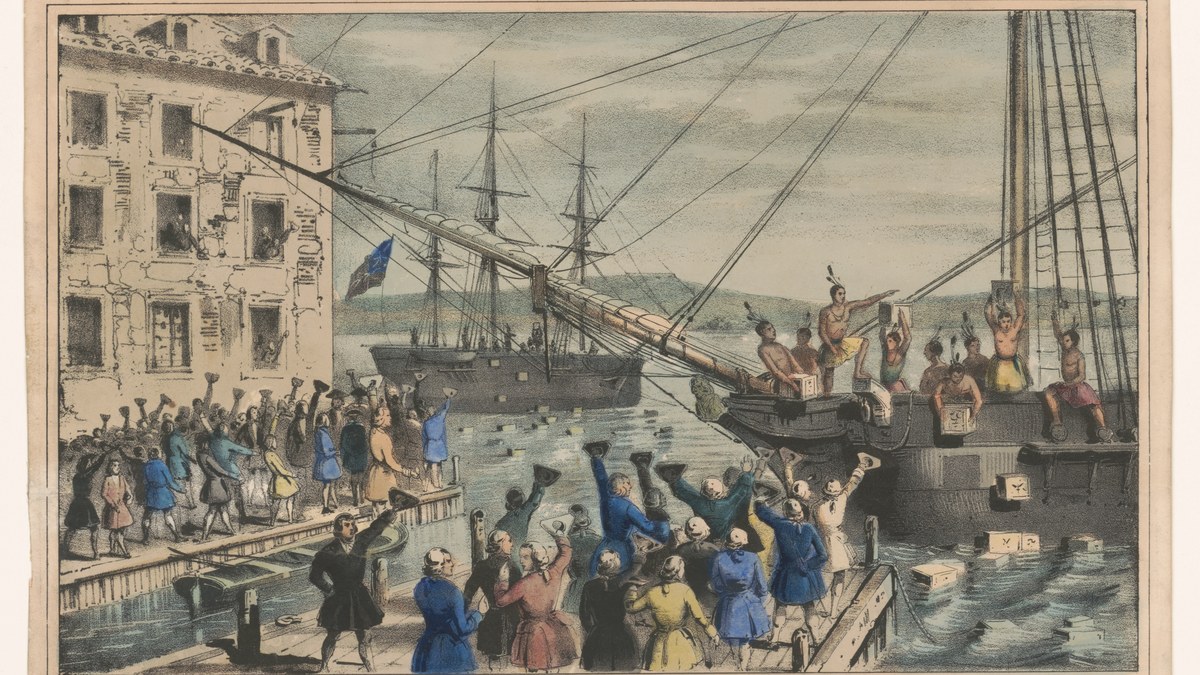
On December 17, 1773, John Adams sat down with his diary and began with the news.
"Last Night 3 Cargoes of Bohea Tea were emptied into the Sea."
A few lines later he added his verdict: "This is the most magnificent Movement of all."
Adams did not call it a party. The surviving accounts from that winter call it the destruction of the tea. The schoolbook version gets the spirit right and a good many of the details wrong, starting with the price.
More American Memories
Explore Our "Remember When" Archive of Treasured Decades →The schoolbook version
Britain raised the tax on tea. Angry colonists dressed up as Mohawk warriors. Samuel Adams stood up in a packed meeting and gave the signal. A band of patriots rushed to the harbor and threw the tea overboard.
Some of that is true. Some of it came much later.
What the record shows: legal tea got cheaper
Parliament passed the Tea Act on May 10, 1773. It did not raise the tax on tea. It helped the East India Company sell tea in America by letting it ship directly to the colonies and sell through a few merchants it chose, called consignees.
The result, as the National Park Service explains, was legal tea that cost less than the Dutch tea smugglers brought in.
So what was the problem? The tax that already existed stayed in place. Paying it, even on cheaper tea, meant accepting that Parliament could tax Americans who had no vote in it. And the Company's handpicked consignees threatened to cut out the local merchants who had been selling tea all along. The fight was about principle and power, not the price of a cup.
Three ships and a deadline
The first tea ship, the Dartmouth, reached Boston on November 28 with 114 chests aboard. Two more, the Eleanor and the Beaver, followed and were tied up at Griffin's Wharf by mid-December. A fourth, the William, never made it. It was wrecked on Cape Cod in a storm on December 10.
For the Dartmouth, the deadline to land the tea and pay the duty was December 17.
On December 16, thousands of people crowded into the Old South Meeting House. The Park Service says as many as 5,000. A merchant named John Andrews, writing two days later, put it at five or six thousand.
The Dartmouth's owner, Francis Rotch, had spent the day going from office to office trying to get permission to sail the ship back to England with the tea still aboard. Late that afternoon he returned from the governor, Thomas Hutchinson. The answer was no. Hutchinson would not give the ship a pass until customs had cleared it, and customs would not clear it with the tea aboard.
You may have read that Samuel Adams then rose and said, "This meeting can do nothing more to save the country." That line is attributed to him in later accounts, but no word-for-word record from that night survives. What the Massachusetts Historical Society can say is that the meeting broke up and a group of men in disguise headed for the wharf.
Blankets and soot
The disguises were rough. Eyewitnesses described blankets, ragged clothing, and faces blackened with lampblack or soot. Some accounts say the men were dressed as "Indians" or as Mohawks. The feathered headdresses in later paintings were added by the artists.
How many men boarded the ships is uncertain. The Massachusetts Historical Society gives 30 to 60. The Park Service describes about 150.
They worked for about three hours. Andrews wrote that "Before nine O Clock in ye eveng, every Chest, from on board the 3 vessells, was knocked to pieces and Flung over ye sides."
How much tea
A Boston newspaper and the Park Service count 342 chests. The East India Company's own invoice, filed when it asked to be paid back, lists 340. Either way, it was more than 92,000 pounds of tea. The Company valued it at £9,659 6s 4d.
It was five kinds of tea: Bohea, Congou, and Souchong, which are black teas, and Singlo and Hyson, which are green. The tea came from China, not India.
The men were careful about everything else. A Boston paper reported a week later that no other property was harmed. When a padlock on one of the ships was broken, "another was procured and sent to" the captain. "The town was very quiet during the whole Evening and the Night following," the paper said.
Andrews also wrote that one man, a "Capt Conner," was caught stuffing tea into the torn lining of his coat.
Where the name came from
The phrase "Boston Tea Party" came along decades later. It shows up in the 1830s memoir of George R. T. Hewes, who had been there, based on interviews given when he was in his 90s. The National Archives says the event was not known by that name for about 50 years.
What came next
Britain answered in 1774. Parliament passed what it called the Coercive Acts and the colonists called the Intolerable Acts. The first of them closed the port of Boston on June 1, 1774, until the tea was paid for.
Even Benjamin Franklin thought Boston should pay. "I did once wish the destroy'd Tea to be voluntarily paid for, before this or any compulsory Act should be formed," he wrote in September 1774. The records that survive show no payment.
- A little of the tea survived. The Massachusetts Historical Society holds a glass bottle of tea leaves said to have been gathered on the shore at Dorchester Neck on December 17, 1773.
-
🏛️
Old South Meeting House, where the meeting was held, Boston: revolutionaryspaces.org ↗
-
🏛️
Boston Tea Party Ships and Museum, with replica ships and the Robinson Tea Chest, which the museum calls the only known surviving chest: bostonteapartyship.com ↗
-
🏛️
The bottle of tea leaves, Massachusetts Historical Society: masshist.org ↗
-
🏛️
The Griffin's Wharf marker, at Congress and Purchase streets. The wharf itself is under later landfill: osmh.org ↗
Join the Conversation
"What did you learn about the Boston Tea Party in school, and does any of it surprise you now?"
DailyVibeX American History Community
- Founders Online (National Archives), John Adams diary, December 17, 1773: https://founders.archives.gov/documents/Adams/01-02-02-0003-0008-0001 ↗
- Massachusetts Historical Society, Adams Papers digital edition, diary of John Adams: https://www.masshist.org/publications/adams-papers/index.php/view/DJA02p87 ↗
- Massachusetts Historical Society, "Coming of the American Revolution: The Boston Tea Party": https://www.masshist.org/revolution/teaparty.php ↗
- Massachusetts Historical Society, Boston Tea Party collections feature: https://www.masshist.org/features/boston-tea-party ↗
- Massachusetts Historical Society, John Andrews letter, Object of the Month, December 2023: https://www.masshist.org/object-of-the-month/objects/december-2023 ↗
- Massachusetts Historical Society, bottle of tea leaves: https://www.masshist.org/database/231 ↗
- Massachusetts Historical Society, Edes punch bowl: https://www.masshist.org/object-of-the-month/objects/the-party-before-the-boston-tea-party-2009-08-01 ↗
- National Park Service, "Boston Tea Party Timeline": https://www.nps.gov/articles/000/boston-tea-party-in-real-time.htm ↗
- National Park Service, Old South Meeting House: https://www.nps.gov/bost/learn/historyculture/osmh.htm ↗
- National Park Service, "Boston Tea Party 250": https://www.nps.gov/articles/000/boston-tea-party-250.htm ↗
- National Park Service, "Samuel Adams: Boston's Radical Revolutionary": https://www.nps.gov/articles/000/samuel-adams-boston-revolutionary.htm ↗
- Library of Congress, Continental Congress timeline, 1773 to 1774: https://www.loc.gov/collections/continental-congress-and-constitutional-convention-from-1774-to-1789/articles-and-essays/timeline/1773-to-1774/ ↗
- Library of Congress, "Colonies' Rebellion, 1773 to 1774": https://www.loc.gov/classroom-materials/united-states-history-primary-source-timeline/american-revolution-1763-1783/colonies-rebellion-1773-1774 ↗
- Library of Congress, N. Currier, "Destruction of tea at Boston Harbor," 1846: https://www.loc.gov/item/91795889/ ↗
- U.S. National Archives, 250th anniversary of the Boston Tea Party: https://visit.archives.gov/whats-on/explore-exhibits/250th-anniversary-boston-tea-party ↗
- UK National Archives, Tea Act extract: https://www.nationalarchives.gov.uk/education/resources/boston-tea-party/boston-tea-party-source-2b/ ↗
- UK National Archives, 1773 Boston newspaper account: https://www.nationalarchives.gov.uk/education/resources/boston-tea-party/boston-tea-party-source-4/ ↗
- UK National Archives, East India Company invoice: https://www.nationalarchives.gov.uk/education/resources/boston-tea-party/boston-tea-party-source-6/ ↗
- UK National Archives, request for compensation: https://www.nationalarchives.gov.uk/explore-the-collection/stories/request-for-compensation-for-the-boston-tea-party/ ↗
- Founders Online (National Archives), Benjamin Franklin to Jonathan Williams, September 28, 1774: https://founders.archives.gov/documents/Franklin/01-21-02-0169 ↗
- Founders Online (National Archives), Benjamin Franklin to Thomas Cushing, March 22, 1774: https://founders.archives.gov/documents/Franklin/01-21-02-0065 ↗
- Founders Online (National Archives), John Adams, June 20, 1774, editorial note: https://founders.archives.gov/documents/Adams/01-02-02-0004-0004-0001 ↗
- Old South Meeting House, Boston Tea Party FAQ: https://www.osmh.org/history/boston-tea-party/frequently-asked-questions-about-boston-tea-party ↗
- Revolutionary Spaces, Old South Meeting House: https://revolutionaryspaces.org/discover/old-south-meeting-house/ ↗
- Commonwealth of Massachusetts, Commonwealth Museum, "The Boston Tea Party" (Hewes): https://www.sec.state.ma.us/divisions/commonwealth-museum/exhibits/online/the_boston_tea_party/the_boston_tea_party_13.htm ↗
- Huntington Library, "A Retrospect of the Boston Tea-Party": https://www.huntington.org/collections/lib-6902 ↗
- American Antiquarian Society, "Tea Thrown into Boston Harbor": https://www.americanantiquarian.org/library/remembering-the-revolution/tea ↗
- Boston Tea Party Ships and Museum: https://www.bostonteapartyship.com/ ↗
- Boston Tea Party Ships and Museum, the ship William: https://www.bostonteapartyship.com/tea-blog/the-4th-boston-tea-ship-the-william ↗
Sponsored Historical & Heritage Features
Step Into Pine Hollow: 20 Complete American Stories
Warm, character-rich tales of small-town resilience, family heirlooms, and neighborly kindness.
Explore All 20 Stories →More Surprising American History
Did Paul Revere Really Shout "The British Are Coming"?
The line everyone learned isn't in any of Revere's own accounts. What he did that night, in his own words, is a better story than the poem.
How Did George Washington Die? His Last Day in 1799
A ride in the snow, a sore throat, and less than a day of illness. How George Washington died on December 14, 1799, from the account of the man who sat with him.
Why Veterans Day Is on November 11
The date comes from one hour in 1918. The name came from a veteran in Birmingham, Alabama. And for a few years in the 1970s, the holiday wasn't in November at all.