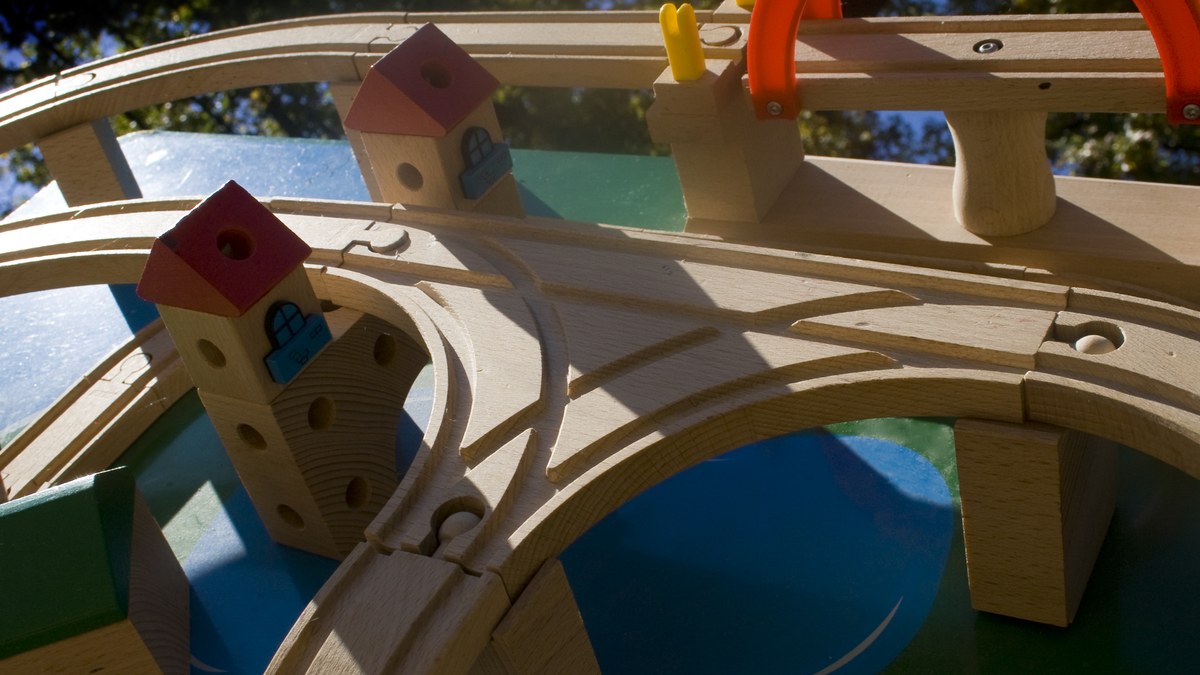
Plenty of us had at least one toy that nobody bought. A top that spun on the kitchen floor. A little car with wobbly wheels. A notched stick with a propeller that only Grandpa could get to spin the "right" way. These toys came out of home shops for generations, and they are still some of the best gifts you can make.
The wooden toys we grew up with
Folk toys. The West Virginia Encyclopedia's entry on toymaking lists the classics of Appalachian homes: the whimmydiddle, Jacob's ladder, limber jack, and tops.
- The gee-haw whimmy diddle is a notched stick with a small propeller on the end. Rub another stick across the notches and the propeller spins. Say "gee" or "haw" and, with a little sleight of hand, it changes direction.
- The limberjack is a jointed wooden man held over a thin paddle. Tap the paddle and he dances.
- The Jacob's ladder is a string of wooden blocks joined with ribbon. Tip the top block and the others seem to tumble down the ladder.
Store-bought wood toys. Two of the most famous wooden toys were invented in this same era:
- Tinkertoy began production in 1914, made by Charles Pajeau and Robert Petit, according to The Strong National Museum of Play. It entered the National Toy Hall of Fame in 1998.
- Lincoln Logs were created by John Lloyd Wright, son of architect Frank Lloyd Wright, inspired by the timber foundation of his father's Imperial Hotel in Tokyo. The Smithsonian's Lemelson Center notes that Wright received his patent in 1920. Lincoln Logs joined the National Toy Hall of Fame in 1999.
And in 2008, The Strong inducted the humblest wooden toy of all: the stick.
Project 1: A gee-haw whimmy diddle
You need: a 1/2 inch dowel or a straight hardwood stick about 9 inches long, a second stick about 6 inches long for rubbing, a scrap of thin wood about 2 inches long and 1/2 inch wide for the propeller, and a small nail or brad.
Project 2: A 2x4 push car
You need: a 6 inch piece of 2x4 (actually 1 1/2 x 3 1/2 inches), four 2 inch wooden wheels, axle pegs or a dowel that fits the wheels, sandpaper, and glue.
Safety rules for toys for young children
The Consumer Product Safety Commission (CPSC) has clear rules, and they are worth following even for a gift:
- Small parts. A toy for a child under 3 may not have any part, or any part that breaks loose in normal rough play, that fits completely inside the CPSC test cylinder, which is 1.25 inches wide and 2.25 inches long. Axle pegs are small, so they must be glued in so they cannot come loose. If in doubt, give the car to an older child.
- Edges and points. CPSC requires toy edges to be free of burrs and sharp points, and wheels and axles must not create cutting, puncture, or swallowing hazards.
- Paint. For children's products, CPSC limits lead to 90 parts per million in paint and surface coatings and 100 ppm in the toy itself.
If you plan to sell your toys, even at a craft fair, CPSC's children's product rules still apply to small makers. Some small-batch makers get relief from third-party testing, but they still need to meet the safety rules, add tracking labels, and issue a Children's Product Certificate. Check CPSC's guidance for small businesses before you sell.
Grandpa made toys from whatever was in the scrap bin and a pocketknife. That still works. Today we just add one more step: sand it smooth, glue it tight, and think about who will be playing with it.