If you stayed up late enough, usually on a weekend, you could watch television go to sleep.
The last movie ended. An announcer thanked you for watching and told you what time the station would be back. Then came the national anthem, the flag waving, fighter jets crossing the sky. And then, nothing. A screen full of static and a steady hiss, or a test pattern with a long, flat tone that seemed to go on forever.
That was your cue to go to bed. Most of us knew we were already in trouble.
Why Stations Went Off the Air
For most of TV's early decades, local stations simply didn't broadcast all night. Overnight audiences were small, and running a transmitter and paying a crew to air programs for a few viewers didn't make sense.
Sign-off also gave engineers time to work on the equipment. Transmitters and studio gear needed maintenance and adjustment, and the quiet hours were when they could do it.
The Sign-Off Ritual
Every station had its own version, but the order was familiar:
- **An announcement** with the station's call letters and a thank-you to viewers, often with the time it would come back on.
- **Sometimes a short religious message** or prayer, especially on local stations.
- **"The Star-Spangled Banner"** over a montage of flags, landmarks, and military footage.
- **Static, or a test pattern** with a tone, until morning.
Many stations also closed with "High Flight," a 1941 poem by John Gillespie Magee Jr., a young American pilot flying with the Royal Canadian Air Force. Read over film of a jet climbing through clouds, its lines about slipping "the surly bonds of earth" were the last thing a lot of us heard before the static.
That Test Pattern
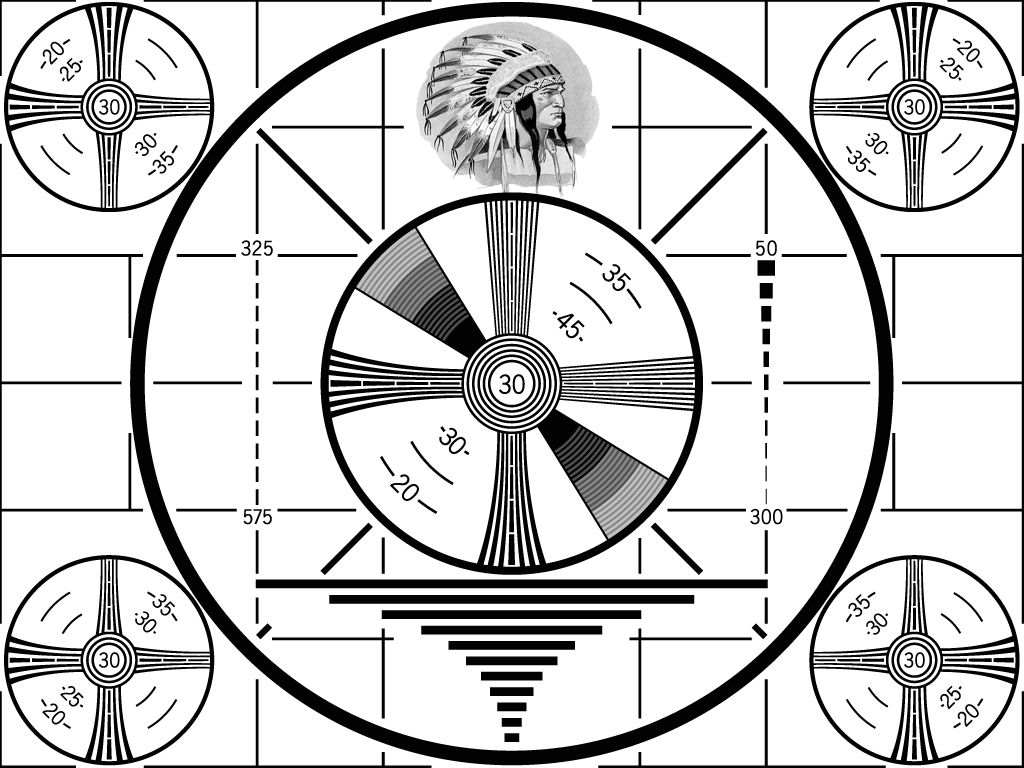
The most famous American test pattern was created by RCA and introduced in 1939. It showed circles, lines, and number scales, with a drawing of a Native American man in a feathered headdress at the center. Viewers called it the Indian-head test pattern.
It wasn't just a placeholder. TV technicians and owners used those lines and circles to adjust picture quality. The pattern faded out as color TV took over in the 1960s, and stations moved to color bars instead.
Why It Stopped
No single day ended the sign-off. It disappeared station by station over the 1980s and '90s.
Cable never slept. CNN launched in 1980 with round-the-clock news, and other cable channels followed. Local stations suddenly had competition at 2 a.m.
Overnight shows filled the hours. Old movies, reruns, overnight news, and later paid programs and infomercials gave stations something to air, and something to sell, all night long.
Equipment got better. Newer transmitters needed less overnight tinkering, so going dark wasn't necessary anymore.
Still Around?
A few small stations still sign off overnight, and some public stations kept the tradition for years. But mostly, the sign-off lives on in old tapes. Collectors have saved hundreds of local sign-offs, and watching them now is a strange comfort: the same anthem, the same jets, and a station that wanted to say goodnight.
What was the latest you ever stayed up as a kid, waiting for the TV to sign off?
Sources
- "Indian-head test pattern," Wikipedia, and MediaCollege.com (RCA, 1939)
- "Please Stand for the 'Star-Spangled Banner' as Featured in These '70s-'90s TV Station Sign-Offs," *Remind Magazine*, July 2023
- "Sign-on and sign-off," Wikipedia (sign-off sequence)
Related Reading
- [another remember-when slug]
- [another category slug]