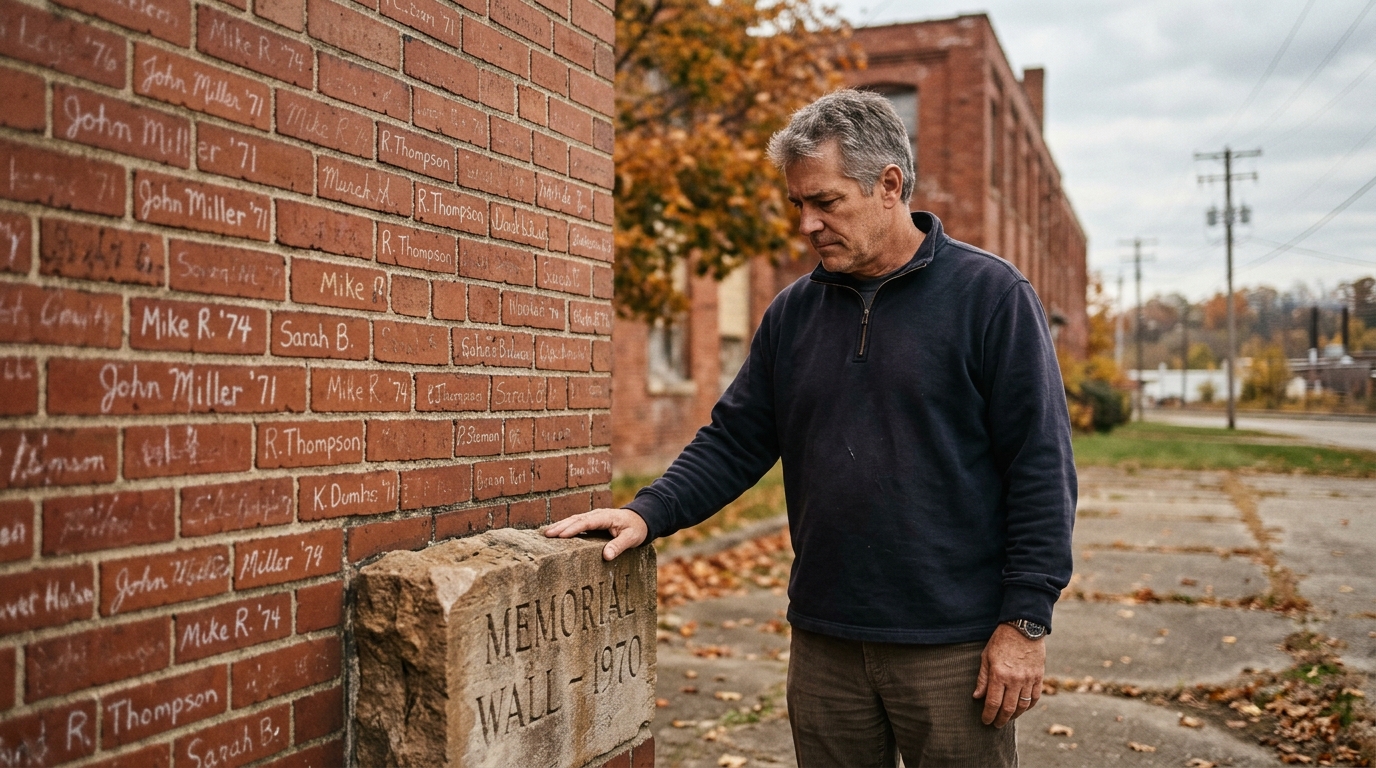
Grady Pruitt had been waiting nineteen years for a deal like this, and he was not about to let a wall get in the way.
"Forty acres," said Lauren Shaw, walking beside him across the cracked parking lot of the old Calder Glass Works. She was from the logistics company in Indianapolis, with a hard hat she clearly didn't need and a tablet she clearly did. "A distribution center. Two hundred jobs in the first year. We close Friday, we break ground in March."
"Two hundred jobs," Grady said, the way some men say *I love you*.
He had brokered the whole thing. Eleven months of phone calls, county meetings, and lunches he couldn't afford. His commission was forty thousand dollars. He had already spent some of it in his head.
More than that, it was the thing he would run for county commissioner on. *Grady Pruitt brought the jobs back.* He could see the yard signs.
The glass works had been empty since 1986. Most of the buildings had fallen in on themselves years ago. All that was left standing was the old break building by the furnace yard. Two stories of red brick, broken windows, pigeons in the rafters.
"That comes down Thursday," Lauren said. "Our demolition crew is already scheduled. Then the site's clear for closing."
"Wonderful," said Grady.
They walked inside so Lauren could take pictures for her report.
The break room was on the ground floor. Long, narrow, with a concrete floor and one whole wall of painted white brick. Grady had never been inside. He'd made a point of never coming out here at all.
Lauren stopped. "Oh," she said. "Wow."
The white wall was covered in names.
Hundreds of them. Maybe a thousand. Written in pencil and marker and paint, scratched in with nails and pocketknives. Every one had a year next to it. 1951. 1958. 1964. They went from the floor up as high as a man could reach standing on a chair.
Some had little notes. *Furnace line, 30 yrs.* *Last shift, 3/14/86.* *Ain't we got fun.*
"It's a tradition, I guess," Lauren said, snapping pictures. "Your first day, you sign the wall. Cool. Too bad, though."
"Too bad?"
"It's coming down Thursday." She shrugged. "We can't delay. The financing's tied to the closing date. If we're not clear by Friday at five, the board pulls the deal and we go to the site in West Virginia."
Grady nodded. That was fine. Walls were just walls.
He was already turning to leave when his eyes caught on a name about chest high, near the door.
*D. PRUITT. 1971.*
His father.
Dwayne Pruitt had worked the furnace line for fifteen years. When the plant closed in 1986, he started drinking. In 1988 he got in his truck and drove to Texas, and he never came back. He died down there in 2003. Grady found out from a letter.
Grady was fourteen when his father left. He'd spent the rest of his life making sure nobody in Pine Hollow looked at him the way they'd looked at the Pruitt kid in the hand-me-down coat.
He should have kept walking.
Instead, he stepped closer.
Below his father's name, smaller, in the same handwriting, was another line. Drawn in pencil, gone faint, but still there.
*+ GRADY. AGE 6. 1980. Future furnace man.*
And next to it, a tiny, crooked G, the kind a six-year-old makes when his father holds the pencil with him.
Grady stood there a long time.
He had forgotten. He had completely forgotten. The day his father brought him to work on a Saturday. The heat from the furnace. The big hands lifting him up to the wall.
"Mr. Pruitt?" Lauren said from the doorway. "Everything okay?"
"Fine." His voice came out wrong. He cleared his throat. "Fine."
That night, word got out. It always does in Pine Hollow. Somebody's cousin was on the demolition crew. By breakfast, Dot's diner was full of old men who had signed that wall, and every one of them was asking the same question.
At nine o'clock, Lauren Shaw called Grady's cell phone.
"I'm hearing there's going to be a protest," she said. "I need you to handle it. The demolition order needs your signature as the local agent by five o'clock today. Sign it, and we close Friday. Don't, and we walk."
Grady sat in his shiny truck in the diner parking lot, with the order on the seat next to him and a pen in his hand.
Through the window, he could see Earl Whitaker in the corner booth. Earl had signed that wall too.
Grady clicked the pen.