Tyler didn't call the names on the list. He had promised.
Instead, he went to see the one name that wasn't really a name.
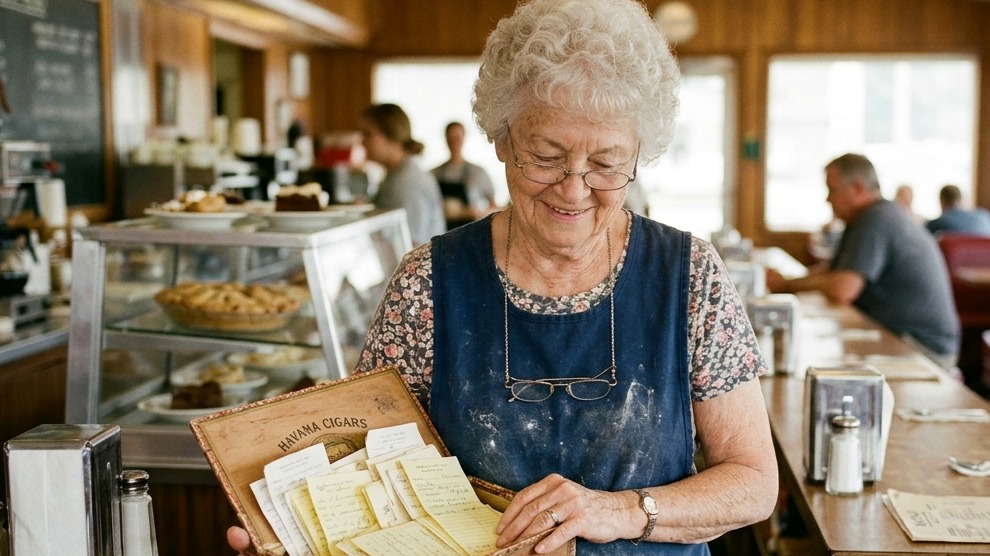
Near the bottom of the box he'd found a slip torn from an order pad, written in a young man's careful block letters:
*One meal a day till I get back on my feet. I'll pay you back, Mrs. K. E.W., 1986.*
There was no amount on it.
Sheriff Earl Whitaker was at his desk Monday morning, reading glasses on, when Tyler laid the slip in front of him.
Earl looked at it a long time.
"I was twenty-three," he said finally. "Worked the furnace line at the glass works. They shut the doors in March and gave us one week's pay. June and I had a baby coming." He took off his glasses. "Your grandmother fed me lunch every day for eleven months. Never once wrote down what I ate. Just that."
Tyler told him about the inspector. About the letter to the real estate agent.
Earl didn't say a word. He picked up his hat.
"She told me not to ask anybody," Tyler said.
"Then we won't ask," Earl said. "We'll tell them."
Earl didn't make an announcement. That's not how things get done in Pine Hollow.
He made phone calls. Quiet ones. He sat at the feed store counter longer than usual. He stayed late at the VFW fish fry. After church on Sunday, he had a word with Pastor Sam Greer, who listened, nodded, and said, "Leave it to me."
Mike Sorensen ran a heating and electrical business out of Marietta now. His father's name was on one of those 1986 slips. *Supper for the family.*
Mike called Tyler that night. "I can get a hood and a suppression system at cost," he said. "And I've got a crew that owes me a favor. When is she away from the diner long enough?"
Hank Doyle said he'd rebuild the walk-in cooler compressor, the one that had been groaning since spring and that Dot had never mentioned to anybody. Walt Brenner measured the kitchen twice and said the new hood needed a header beam, and he'd have one built by Saturday.
Ruth Ann Mercer organized a church lunch so Dot would be sitting in the third pew at Grace Methodist for two straight hours with no reason to go near Main Street.
Tyler added it all up. The labor was covered. Most of the parts were covered.
They were still sixty-two hundred dollars short.
On Thursday, a plain white envelope showed up at the sheriff's office. No return address. Inside was a cashier's check for sixty-two hundred dollars, and a slip of paper.
It was an IOU. Old. Yellowed. Written in a child's big round letters.
*Grilled cheese and milk. G.P., age 9. I will pay it back. 1983.*
Earl turned it over. On the back, in newer ink, someone had written two words.
*Don't tell.*
Earl sat with it a long while. Then he put it in his shirt pocket, and he never told anyone. Not Tyler. Not Dot.
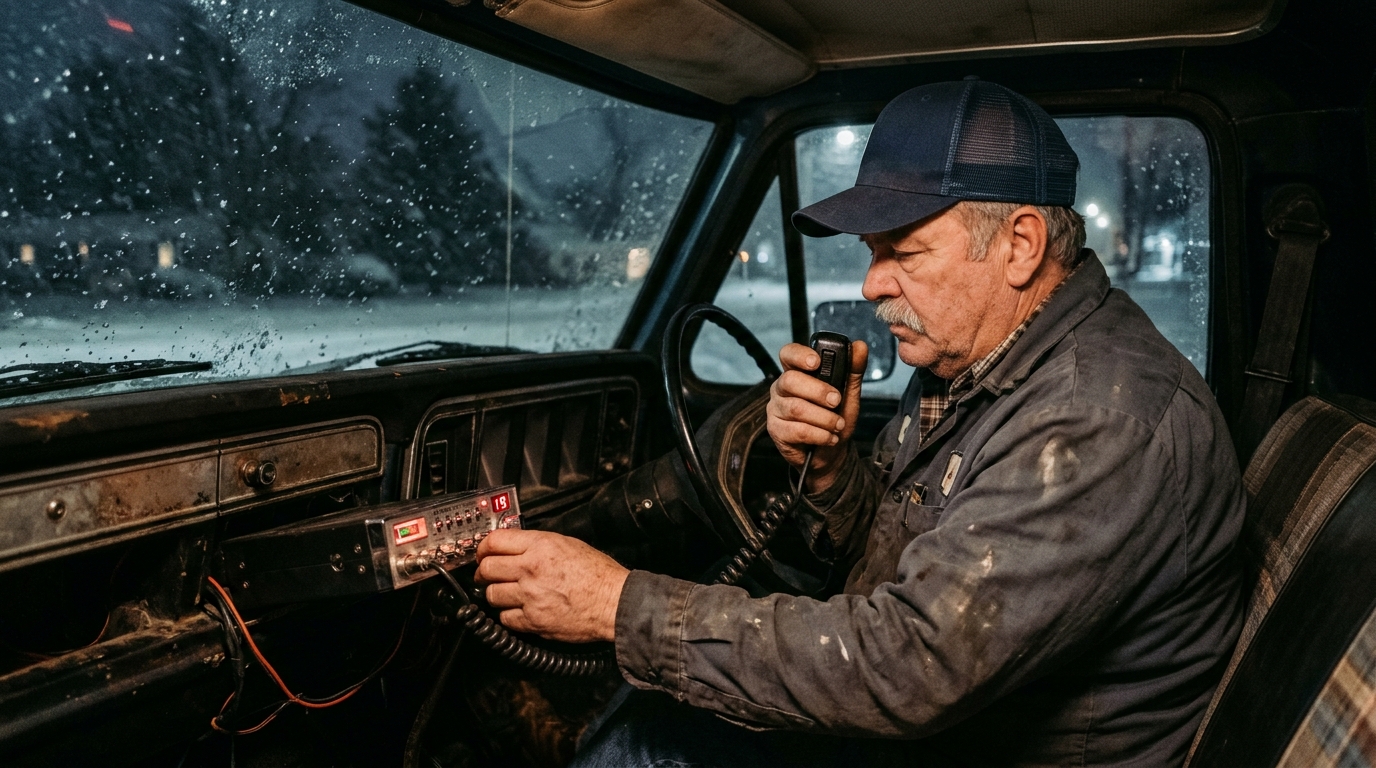
Not even June's picture on the dashboard.
On Sunday, while Dot sat in the third pew listening to a sermon that seemed to run longer than usual, eleven people and two trucks went to work in her kitchen.
At four o'clock, Dot walked down Main Street and stopped on the sidewalk.
The diner lights were on. She hadn't left them on.
She pushed open the door. The bell rang.
The counter was full. All nine stools. Earl, Walt, Hank, Ruth Ann, Pastor Sam, Mike Sorensen, Clay Hollister, and two men from the old glass works crew, both past seventy now. Tyler stood behind the counter in his apron.
Behind him, over the grill, hung a brand-new stainless steel vent hood, shining like a church window.
Nobody said anything.
In front of every stool, face down on the counter, was a slip of paper.
Dot walked down the counter slowly and turned them over, one at a time.
*R.M. Two eggs, toast, coffee. 1980.* Across it, in Ruth Ann's neat teacher handwriting: *PAID.*
*Glass works boys (4). Lunch all week. 1986.* *PAID.*
*Sorensen. Supper for the family.* *PAID.*
*E.W. One meal a day.* *PAID.*
She reached the end of the counter and stood with her back to all of them, both hands flat on the Formica.
"Which one of you," she said, without turning around, "went through my cigar box?"
Tyler raised his hand.
Dot turned around. Her eyes were red. Her chin was up.
"I told you those were receipts."
"I know, Gran," Tyler said. "We figured it was time you got one too."
For a while the only sound in the diner was the new hood humming.
Then Dot sniffed, tied on her apron, and picked up the coffee pot.
"Well, don't just sit there," she said. "Who wants pie?"
Late that night, Tyler came down for water and found the letter to the real estate agent in the kitchen trash, torn into four pieces. He hadn't done it.
The cigar box was back on its shelf behind the napkins. It was empty except for one new slip of paper, in Dot's handwriting.
*Dot owes Pine Hollow. Forever.*
It was the only IOU she ever meant to pay.