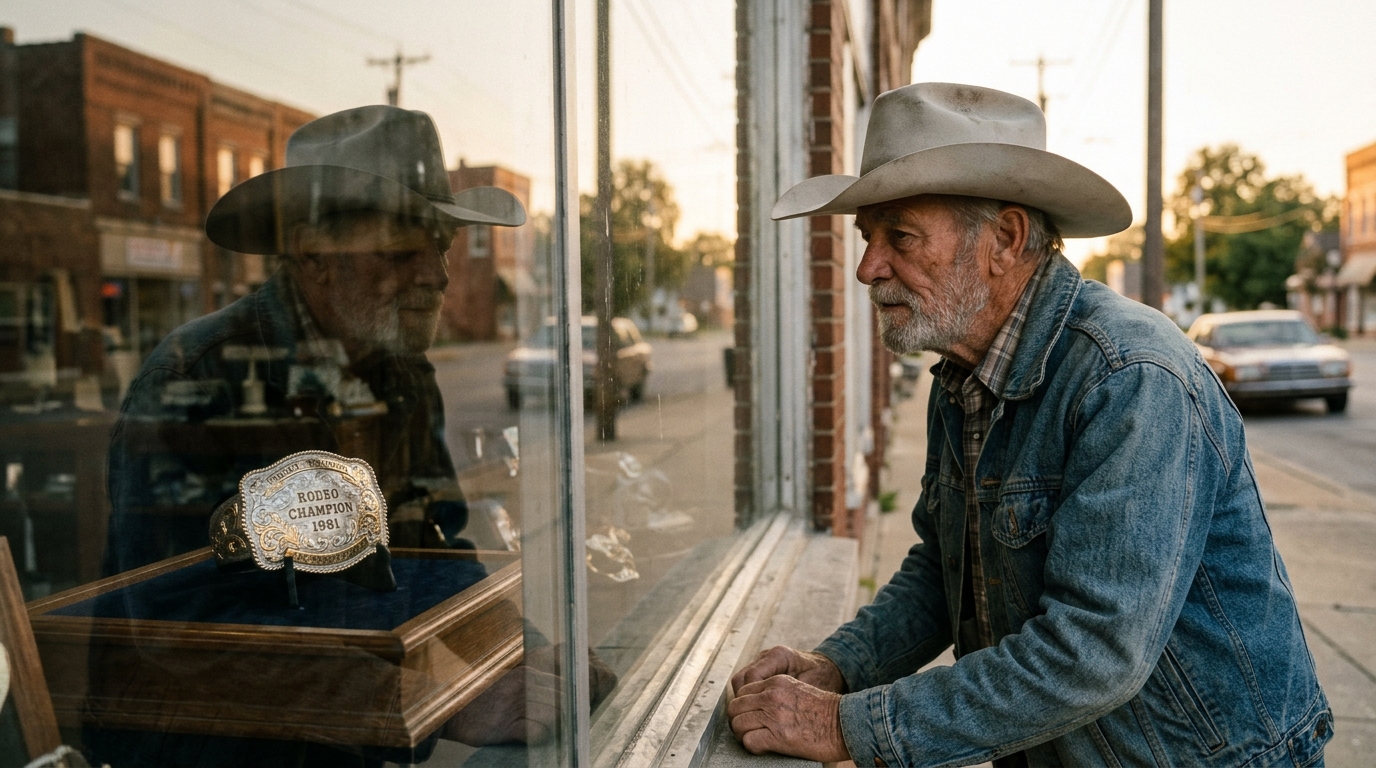
Clay Hollister had walked past the pawn shop on Front Street in Marietta maybe a hundred times. He had never once looked in the window.
Today he did, because Marlene was taking forever in the fabric store next door, and his hip hurt, and there was a bench out front.
He sat down. He glanced at the window.
And there, on a piece of red velvet between a guitar and a set of golf clubs, was his buckle.
He knew it from across the sidewalk. He would have known it from across the state.
Silver, the size of a man's palm, with a gold bronc rider in the middle, the horse bucked straight up and the cowboy's hat flying off. Around the edge, raised letters: SHERIDAN WYO RODEO. 1981. SADDLE BRONC CHAMPION.
Clay had won it on a horse called Widowmaker's Grandson, who was meaner than his name. Eighty-four points. The best ride of his life. He had worn that buckle every day for seven years.
In 1988, he gave it away.
He stood up and went inside.
The pawnbroker was a heavy, friendly man named Lou, with reading glasses on his head and a cat asleep on the counter.
"The buckle in the window," Clay said. "Where'd it come from?"
"Can't tell you that, friend. Privacy." Lou looked at him a little closer. "Why? You a collector?"
"I won it."
Lou took his glasses off his head and put them on. He looked at Clay's face. Then at the buckle. Then back at Clay. He went and got the buckle out of the window and set it on the counter.
On the back, scratched in small letters with a pocketknife, it said: *C.H. to D.D. Ride 'em till they quit. 1988.*
"Well, I'll be," Lou said quietly.
Clay picked it up. It was heavier than he remembered.
In 1988, Clay Hollister was thirty-four, and his body was telling him it was time to quit. His hip had never been right since the wreck in Cheyenne in 1983. That summer, at a little rodeo in Montana, he met a skinny nineteen-year-old kid named Dusty Doran, who rode broncs like he was born on one and had nothing else in the world.
Dusty had no father, no money, and no saddle that wasn't held together with baling wire. Clay spent the whole summer teaching him. In August, at his last rodeo, Clay took off the buckle and put it in Dusty's hand.
"Ride 'em till they quit," he told him.
They wrote a few letters. Then fewer. Then none. That was how it went in those days. Clay heard Dusty had settled down somewhere back east. He always meant to look him up.
He never did.
"Lou," Clay said. "I'm not asking for a name. I'm asking if it's for sale."
Lou looked at a slip of paper taped to the case. "Not yet. It's pawned, not sold. That means somebody borrowed money against it. Four hundred dollars. If they pay me back by the due date, plus interest, they get it back."
"And if they don't?"
"Then it's mine, and it goes in the window with a price tag." Lou looked at the clock on the wall. "The loan's due today. Five o'clock."
The clock said 4:31.
Clay sat down on the stool by the counter.
"Mind if I wait?"
"Suit yourself."
Marlene came looking for him at 4:45. She took one look at the buckle on the counter and sat down next to him without a word. Thirty-eight years of marriage teaches you when to talk.
At 4:52, nobody had come.
At 4:56, Lou picked up a price tag and a pen.
At 4:58, the door banged open.
A teenage boy came in, out of breath, like he'd run the whole way. Seventeen, maybe. Tall and thin, in a Carhartt jacket that was too big for him and a pair of beat-up boots. He had a fistful of cash, crumpled bills, a lot of fives and ones.
"Lou," he said, gasping. "I've got it. I've almost got it. I'm forty short. I get paid Friday. Please. Please don't sell it."
Lou looked at him sadly. "Son, you know I can't..."
But Clay wasn't listening to Lou anymore.
He was looking at the boy's face. The long jaw. The way his eyes were set. The little tilt of his chin, like he'd already been knocked down a few times and was waiting to see what came next.
Clay had seen that face before. In Montana. In the summer of 1988.
"Son," Clay said slowly. "What's your name?"