Can you stand on one leg for 10 seconds without grabbing the counter? A seven-year study found that adults ages 51 to 75 who couldn't do it had a higher risk of dying during follow-up. That sounds like a frightening test until you understand its limits.
It can't predict your future, and it won't tell you everything. It can tell you that balance, leg strength, vision or steadiness deserves a closer look.
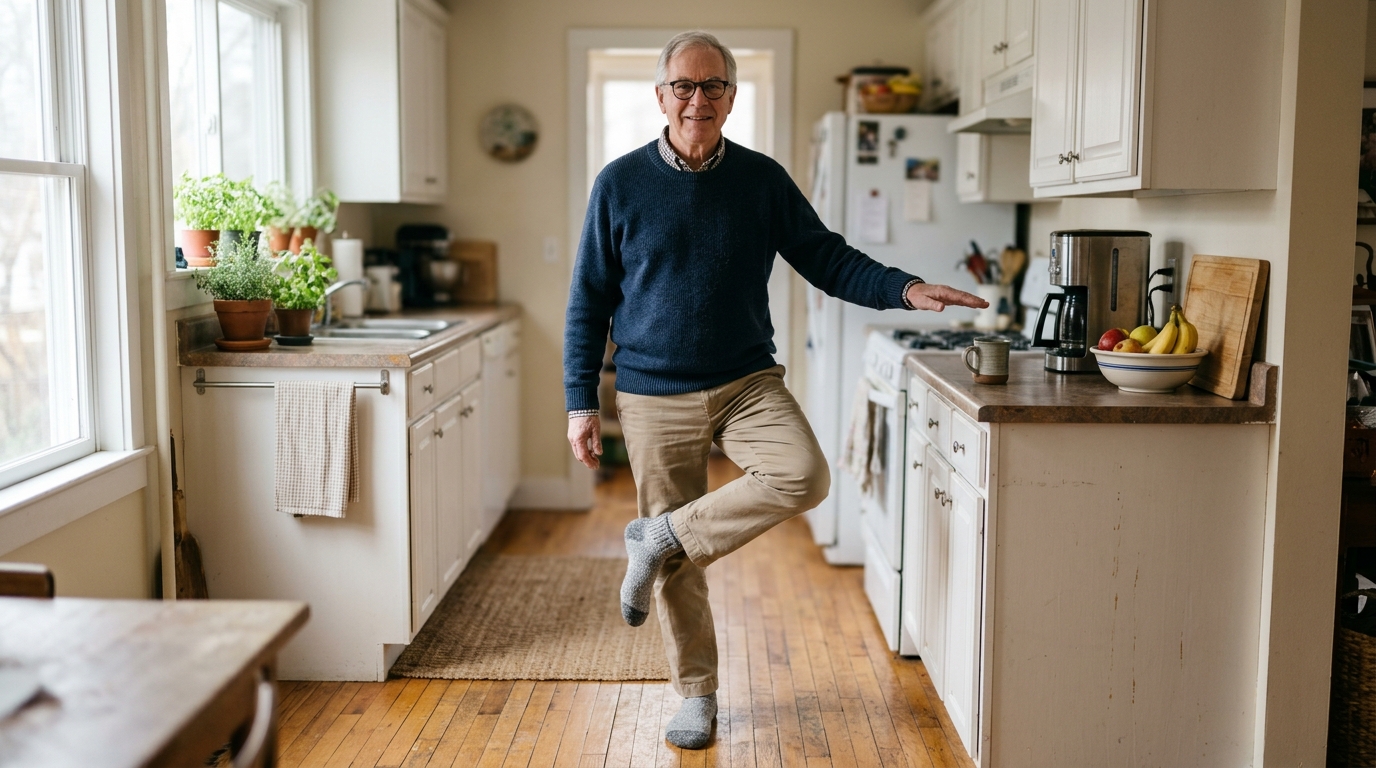
Try it beside a kitchen counter, not beside a slick bathtub. Ten seconds isn't worth a fall.
- ✓Failing the 10-second stand was linked to higher mortality in one observational study.
- ✓The test doesn't prove poor balance causes early death.
- ✓Try it beside a sturdy counter, and ask your doctor about unsteadiness.
What the researchers actually did
At an exercise medicine clinic in Rio de Janeiro, Brazil, doctors tested 1,702 people between 2008 and 2020. Participants were between 51 and 75 years old, with an average age of 61, and everyone could walk normally. The challenge was simple: stand on one leg for 10 seconds without touching anything.
Roughly 1 in 5 people couldn't finish it.
The researchers followed the group for a median of about seven years. Among those who failed, 17.5% died. Among those who passed, 4.6% died. The first figure was nearly four times the second.
Age, sex, body weight and other health conditions were included in the researchers' adjustments. Even after that, failing the stand was linked to an 84% higher risk of dying from any cause during the study. The results were published in the British Journal of Sports Medicine in 2022. Ten seconds is a short test, but it asks a lot of your body.
A clue, not a crystal ball
This was an observational study, so it found an association rather than proving cause and effect. The researchers didn't have information about recent falls or how much participants exercised, and either detail could matter. No single balance test can describe your whole health, and it shouldn't be asked to.
Standing on one leg asks several systems to cooperate. Your ankles have to steady you, your legs have to hold you up and your eyes have to give the brain a clear target. The inner ear matters, too, and you'll notice when the systems aren't working together.
The percentage of people who failed roughly doubled with every five years of age, beginning in the early 50s. Balance doesn't always fade in a smooth, gentle line; it tends to drop faster after the mid-50s.
If you wobble, don't label yourself doomed. Treat the result as a prompt to ask what changed and what could help.
Set up the test like a cautious adult
Stand beside a kitchen counter or a sturdy chair. If you've fallen in the past year, have someone nearby. Don't try it if you're dizzy, recovering from an injury or your doctor has told you to avoid balance exercises. In the study, a doctor or nurse stood in front of each participant in case they tipped.
Here's roughly how the researchers ran it:
- Take off your shoes. Stand on a flat floor beside the counter.
- Lift one foot. Rest its top against the back of the other lower leg.
- Look straight ahead. Keep your arms at your sides and choose a spot on the wall.
- Hold for 10 seconds. Don't touch anything. You get up to three tries on either foot.
If you can hold the position, good. If you can't, you're in familiar company: about 1 in 5 people in the study couldn't either.
Winter gives a wobble less room
The CDC says that more than 1 in 4 Americans over 65 fall every year, and less than half tell their doctor. Falls are the leading cause of injury death in that age group. After one fall, your chances of another one double.
An icy porch step or slick driveway can turn a small wobble into a broken hip. Falls aren't a normal part of aging, the CDC says, and many contributors can be fixed. Tell your doctor about a fall even if you weren't hurt. Ask for a fall-risk check. Review medicines that can make you dizzy or sleepy, get your eyes checked once a year and wear shoes with real grip before heading out on an icy morning.
Build steadiness into ordinary days
Balance practice doesn't need a gym membership. It does need something sturdy within reach.
1. Hold the chair first. The National Institute on Aging suggests standing on one foot behind a sturdy chair for up to 10 seconds, then switching legs. As it gets easier, use one hand, one finger and then no hand.
2. Walk a straight hallway. Put one heel just ahead of the opposite toes and take 20 steps. Keep a hand near the wall if you need it.
3. Try Tai Chi. The CDC recommends it for leg strength and balance. Senior centers and community centers often have beginner classes.
4. Work the lower body. The NIA recommends back leg raises, side leg raises and toe stands.
5. Remove a likely troublemaker. Ask your doctor or pharmacist to review medicines that may make you dizzy or sleepy. Keep annual eye appointments and wear shoes with real grip.
NIA says balance exercises can fit into any routine. Waiting for coffee to brew counts. If you have heart, joint or balance problems, ask your doctor before starting something new.
When to call your doctor (or 911)
Tell your doctor if you couldn't do the test, feel unsteady when you stand or walk, or have fallen, even once. A fall-risk check is a normal thing to request.
Put one hand near the counter and try the test when you're rested. If your balance has changed, tell your doctor what you've noticed.
Fact-Checked Medical Sources
- Araujo CG et al. Successful 10-second one-legged stance performance predicts survival in middle-aged and older individuals. British Journal of Sports Medicine, 2022 ↗
- University of Bristol: 10-second one-legged stance (news release, June 2022) ↗
- CDC: Facts About Falls ↗
- CDC: Still Going Strong, Information for Older Adults ↗
- National Institute on Aging: Stand on One Foot Balance Exercise (video) ↗
Last reviewed: November 2026 · Fact-checked & verified