Apollo 8: The Christmas Eve Broadcast From the Moon
On Christmas Eve 1968, three men in orbit around the Moon read the first ten verses of Genesis to the people back home. How it happened, and the photograph from that morning.
On the night of Tuesday, December 24, 1968, a television picture came down from the Moon. It showed the gray surface of the Moon, passing slowly below a spacecraft called Apollo 8.
It was the crew's ninth trip around the Moon. Then Bill Anders spoke.
He said, "For all the people on Earth the crew of Apollo 8 has a message we would like to send you." Then he began to read: "In the beginning God created the heaven and the earth."
Three men and a big rocket
Three days earlier, on Saturday, December 21, at 7:51 a.m. Eastern time, Apollo 8 lifted off from Kennedy Space Center in Florida. It was the first time astronauts had ridden a Saturn V rocket.
More American Memories
Explore Our "Remember When" Archive of Treasured Decades →The crew was Frank Borman, the commander; Jim Lovell, the command module pilot; and Anders, whose title was lunar module pilot even though there was no lunar module on board.
The mission had not always been planned this way. NASA's own history explains that the lunar module, the craft meant to land on the Moon, was running behind schedule. Rather than wait, and to gain experience for the landings to come, NASA changed Apollo 8 into a crewed flight to the Moon itself, without a lander. If it worked, they would be the first humans to leave Earth orbit.
Christmas Eve morning
Early on December 24, Apollo 8 swung behind the Moon and out of contact with Earth. NASA notes that the three men became the first people to see the Moon's far side with their own eyes. Behind the Moon, they fired the engine that put them into lunar orbit. The first orbit was a long oval. A second burn rounded it out at about 70 miles above the surface. They circled ten times in roughly 20 hours, photographing the ground below, including places where later crews might land.
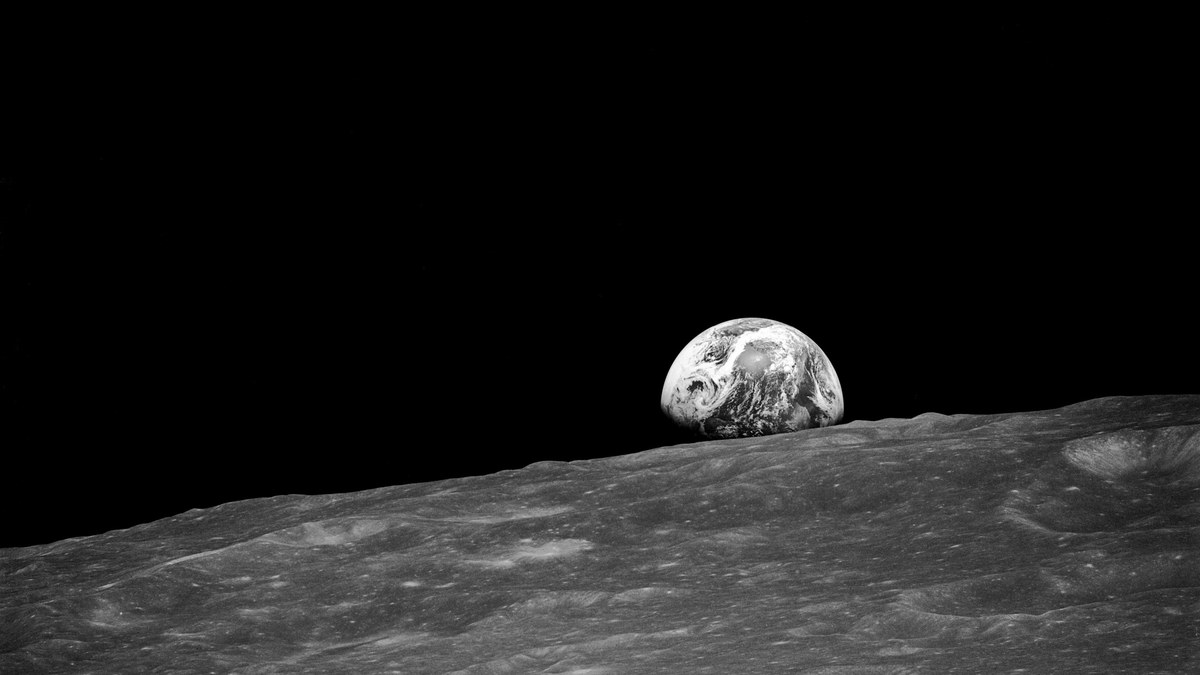
On the fourth time around, at about 10:40 that morning, Houston time, the Earth came up over the Moon's horizon. Anders called to the others to look at the picture out the window. The crew snapped a black-and-white frame first. Then Anders took the color photograph NASA catalogs as AS08-14-2383.
We know it as Earthrise.
"We would like to send you"
Apollo 8 sent six television broadcasts in all, NASA records: two on the way out, two from lunar orbit, and two on the way home. The Christmas Eve broadcast came that night, during the ninth orbit. It lasted about 27 minutes from start to finish. The crew showed the lunar surface and the Earth and talked about what they saw.
Then they read the first ten verses of the Book of Genesis. Anders read verses 1 through 4. Lovell read verses 5 through 8: "And God called the light Day, and the darkness he called Night." Borman read verses 9 and 10.
Then Borman signed off for the crew. He wished the people watching "good night, good luck, a Merry Christmas and God bless all of you" and ended with "all of you on the good Earth."
How they chose Genesis
The crew knew a lot of people would be watching. Borman recalled in a NASA oral history that he had been told it would be "the largest audience" yet, and that he asked a government press official, Simon Bourgin, to help find something appropriate to say. Lovell later said that Joe Laitin, another official, worked on it too, and that Laitin's wife suggested the Bible. They settled on the opening of Genesis.
NASA estimates that about one billion people in 64 countries saw or heard the broadcast. The National Archives gives a lower figure of half a billion.
Christmas morning
One more engine burn stood between the crew and home. After the tenth orbit, early on Christmas Day, the crew had to fire their engine again behind the Moon, out of contact with Earth, to head home. Mission Control had to wait for the spacecraft to come around the Moon's edge to learn whether it had worked.
When the signal came back, Lovell had news for Houston: "Roger, please be informed there is a Santa Claus."
On December 27, Apollo 8 splashed down in the Pacific Ocean, a few miles from the recovery ship, the USS Yorktown. Within about 90 minutes, a helicopter had the three men aboard.
After
The reading also ended up in court. In 1969, Madalyn Murray O'Hair and others sued NASA's administrator over it. A federal district court dismissed the case.
TIME magazine named Borman, Lovell, and Anders its Men of the Year for 1968. On May 5, 1969, the Post Office issued a six-cent stamp based on a NASA photograph of the Earth over the Moon, with the words "In the beginning God..." NASA's photo number for that picture was 68-HC-870, the Earthrise frame.
- The Apollo 8 command module, the small cone the three men lived in for six days, went to the Smithsonian in 1971. It is on loan to the Griffin Museum of Science and Industry in Chicago.
-
🏛️
Earthrise, AS08-14-2383, NASA: nasa.gov ↗
-
🏛️
The broadcast transcript, Apollo 8 Flight Journal, NASA: apollojournals.org ↗
-
🏛️
The Apollo 8 command module, Smithsonian record (on loan to Chicago): airandspace.si.edu ↗
-
🏛️
Henry Crown Space Center, Griffin Museum of Science and Industry, Chicago: griffinmsi.org ↗
-
🏛️
The Apollo 8 stamp, Smithsonian National Postal Museum: postalmuseum.si.edu ↗
Join the Conversation
"Where were you on Christmas Eve 1968, and do you remember watching Apollo 8?"
DailyVibeX American History Community
- NASA, Apollo 8 Mission Details: https://www.nasa.gov/missions/apollo/apollo-8-mission-details/ ↗
- NASA, Apollo 8 mission page: https://www.nasa.gov/mission/apollo-8/ ↗
- NASA, "50 Years Ago: Apollo 8 in Lunar Orbit": https://www.nasa.gov/history/50-years-ago-apollo-8-in-lunar-orbit/ ↗
- NASA, "Apollo 8: Christmas at the Moon": https://www.nasa.gov/missions/apollo/apollo-8-christmas-at-the-moon/ ↗
- NASA, "Dec. 27, 1968: Apollo 8 Returns From the Moon": https://www.nasa.gov/history/dec-27-1968-apollo-8-returns-from-the-moon/ ↗
- NASA, Apollo 8 Earthrise image: https://www.nasa.gov/image-article/apollo-8-earthrise/ ↗
- NASA Science, "The Story Behind Apollo 8's Famous Earthrise Photo": https://science.nasa.gov/resource/the-story-behind-apollo-8s-famous-earthrise-photo/ ↗
- NASA Science, "Apollo 8: First Humans to Leave Earth Orbit": https://science.nasa.gov/resource/apollo-8-first-humans-to-leave-earth-orbit/ ↗
- NASA Scientific Visualization Studio, Earthrise: https://svs.gsfc.nasa.gov/3936/ ↗
- NASA Earth Observatory, "Earthrise Revisited": https://science.nasa.gov/earth/earth-observatory/earthrise-revisited-82693/ ↗
- NASA/JSC, photo record AS08-14-2383: https://eol.jsc.nasa.gov/SearchPhotos/photo.pl?frame=2383&mission=AS08&roll=14 ↗
- NASA, Apollo 8 Flight Journal, Orbit 4: https://apollojournals.org/afj/ap08fj/16day4_orbit4.html ↗
- NASA, Apollo 8 Flight Journal, Orbit 9: https://apollojournals.org/afj/ap08fj/21day4_orbit9.html ↗
- NASA, Apollo 8 Flight Journal, Day 4 and 5: https://apollojournals.org/afj/ap08fj/23day4-5_black.html ↗
- NASA/NSSDC, Apollo 8 Christmas Eve broadcast transcript: http://nssdc.gsfc.nasa.gov/planetary/lunar/apollo8_xmas.html ↗
- NASA/NSSDC, Apollo 8: https://nssdc.gsfc.nasa.gov/planetary/lunar/apollo8info.html ↗
- NASA JSC History Portal, Apollo 8 oral history excerpts: https://historycollection.jsc.nasa.gov/JSCHistoryPortal/history/special_events/Apollo8_excerpts.htm ↗
- NASA JSC Oral History, James A. Lovell, May 25, 1999: https://www.nasa.gov/wp-content/uploads/2025/08/lovellja-5-25-99.pdf ↗
- NASA, Apollo 8 Mission Report: https://ntrs.nasa.gov/api/citations/19700033031/downloads/19700033031.pdf ↗
- National Archives, Eyewitness, Apollo 8: https://www.archives.gov/exhibits/eyewitness/html.php?section=25 ↗
- National Archives, "The Time of Apollo" transcript: https://www.archives.gov/files/social-media/transcripts/transcript-time-of-apollo-649447.pdf ↗
- National Archives, Education Updates, "Religious Freedom": https://education.blogs.archives.gov/2016/04/12/religious-freedom/ ↗
- Smithsonian National Air and Space Museum, Command Module, Apollo 8: https://airandspace.si.edu/collection-objects/command-module-apollo-8/nasm_A19711856000 ↗
- Smithsonian National Air and Space Museum, Apollo 8: https://airandspace.si.edu/explore/stories/apollo-missions/apollo-8 ↗
- Smithsonian National Postal Museum, "Man's First Trip to the Moon": https://postalmuseum.si.edu/exhibition/one-giant-leap-for-mankind/mans-first-trip-to-the-moon ↗
- TIME, 1968 Men of the Year: https://content.time.com/time/specials/packages/article/0,28804,2019712_2019703_2019664,00.html ↗
Sponsored Historical & Heritage Features
Step Into Pine Hollow: 20 Complete American Stories
Warm, character-rich tales of small-town resilience, family heirlooms, and neighborly kindness.
Explore All 20 Stories →More Surprising American History
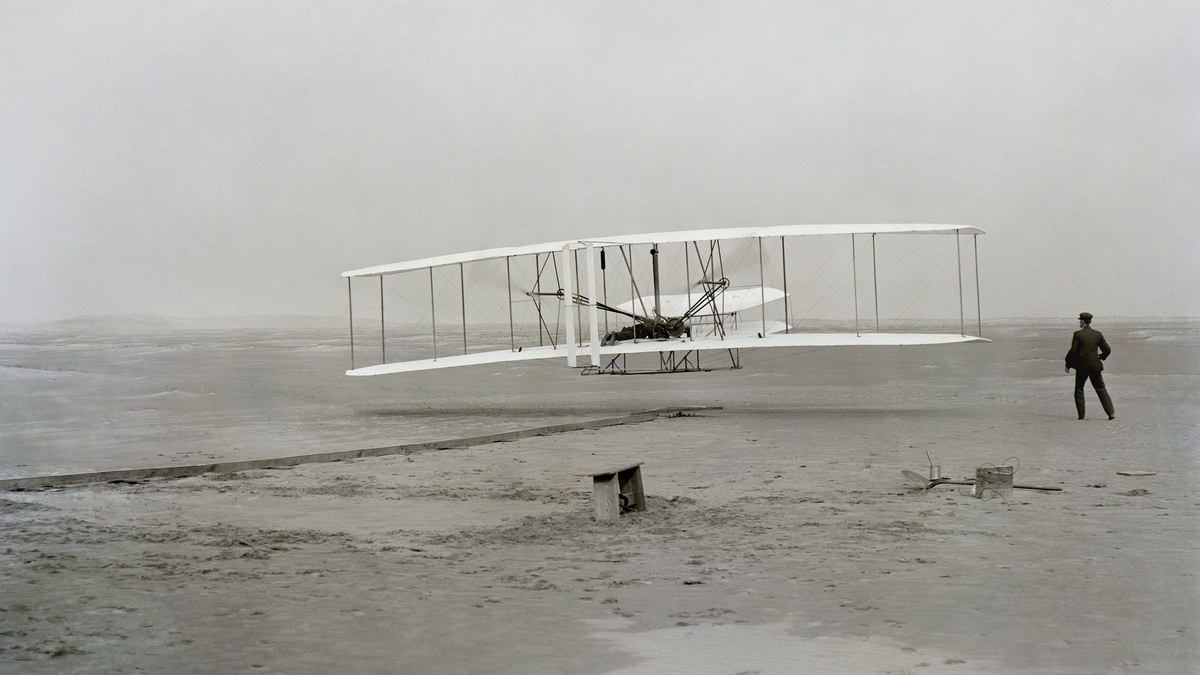
12 Seconds at Kitty Hawk: The Wright Brothers' First Flight
At 10:35 a.m. on December 17, 1903, Orville Wright flew 120 feet in about 12 seconds. The diary, the five witnesses, the photo, and the telegram home.

"Yes, Virginia": The True Story Behind the Letter
It ran in September, not at Christmas. It had no byline. And the girl who asked grew up to spend more than 40 years in New York's schools. The real story of "Yes, Virginia."

Did Paul Revere Really Shout "The British Are Coming"?
The line everyone learned isn't in any of Revere's own accounts. What he did that night, in his own words, is a better story than the poem.