The First Macy's Thanksgiving Parade, 1924
The first Macy's parade, on Thanksgiving morning in 1924, was billed as a Christmas parade, and it ended at a store window. Here is what the newspaper saw that day.
"Santa Claus chose Thanksgiving Day this year to come to town."
That is how The New York Times began its report on Friday, November 28, 1924. The day before, Thursday, November 27, a procession had set off from Convent Avenue and 145th Street in upper Manhattan and made its way down to Macy's on 34th Street. There were floats, bands, clowns, and animals borrowed from the Central Park Zoo. Santa rode on a sleigh float with reindeer, over a mountain of ice.
It was not billed as a Thanksgiving parade. It was the Macy's Christmas Parade, and it had a job to do. It opened the Christmas shopping season at a store that had just grown, and it ended, on purpose, at a store window. The parade many of us will have on this morning started as an advertisement that marched.
A store that had just grown
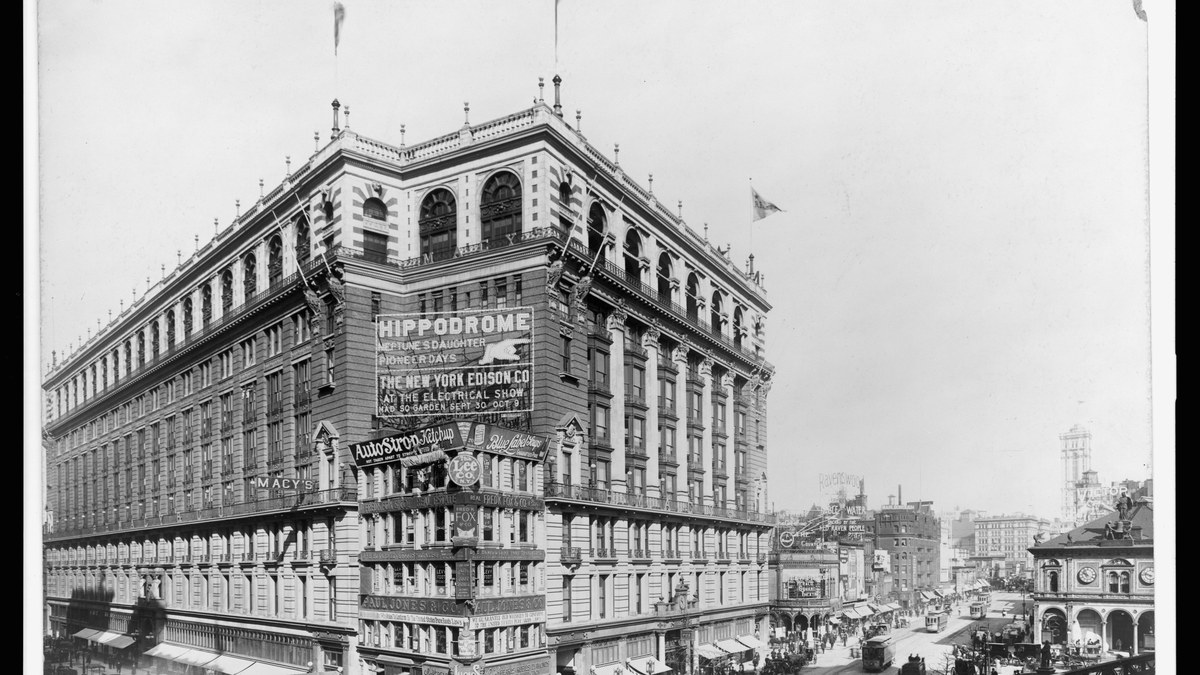
In September 1924, the Times reported the formal opening of a 19-story addition to Macy's, with twelve more acres of floor space. The new section on the Seventh Avenue side had gone up between 1922 and 1924. Now the store filled the block between Broadway and Seventh Avenue, from 34th Street to 35th.
More American Memories
Explore Our "Remember When" Archive of Treasured Decades →Macy's billed it as the largest store in the world. The National Register nomination for the building, prepared for the National Park Service, puts it a little more carefully: the world's largest department store under one roof.
A bigger store needed more shoppers. The Library of Congress describes the parade as an event organized by Macy's employees to boost holiday sales. Thanksgiving was the day it ran. Christmas was the reason.
Who marched
Most of the marchers worked for the store. "The majority of participants were employes of the stores," the Times reported, using the spelling of the day. Employees marched in costume. Clowns and professional entertainers went along with them.
The floats came from the nursery shelf: the Old Lady Who Lived in a Shoe, Little Miss Muffet, and Red Riding Hood. The animals came from the zoo. The Times listed bears, elephants, and donkeys. The Museum of the City of New York lists tigers, camels, elephants, and donkeys. Accounts of the menagerie differ, and you will often see monkeys added to the list. We could not find a record that puts monkeys in the 1924 parade.
The route
The Times printed the route street by street. From Convent Avenue and 145th Street, the parade went down Convent, Morningside, and Manhattan avenues, turned at 110th Street to Broadway, and followed Broadway down to 34th Street.
Later retellings often say the route ran six miles. The Times gave the streets, not a distance. Either way, it was a long walk in costume, and far longer than today's route, which starts at Central Park West and 77th Street.
The timing is a little loose too. The Times reported that Santa arrived at 9 a.m. A preview in Women's Wear Daily two days earlier had announced that the festivities would begin at 8:30.
King of the Kiddies
Three hours after his arrival, Santa reached Macy's. There, on the marquee over the 34th Street entrance, he was crowned "King of the Kiddies."
Police estimated that almost 10,000 people filled the 34th Street block in front of the store. Macy's own history gives the same round number for the first parade. You will also find claims of a quarter of a million people. We could not find any account from 1924 that supports a figure like that.
Then came the moment the whole morning had been building toward. The Times described it this way:
"When Santa seated himself on the throne he sounded his trumpet, which was the signal for the unveiling of the store's Christmas window, showing 'The Fairy Frolics of Wondertown,' designed and executed by Tony Sarg."
That is the part most histories skip. The first Macy's parade did not end with a balloon or a television camera. It ended with a crowd on 34th Street turning to look at a Christmas window.
Macy's was not the only store with the idea
Department stores in other cities were thinking along the same lines. Philadelphia's City Council has recognized a Gimbels parade on November 25, 1920, though the Philadelphia Inquirer notes that the 1920 event was modest and the local papers barely covered it. In Detroit, Hudson's began its own parade tradition in 1924.
How it became the parade we know
The Christmas name did not last long. In 1927, Felix the Cat became the parade's first balloon. With no helium yet, the Museum of the City of New York says, the first Felix was held above the street on long sticks.
For a few years, Macy's let its balloons go after the parade, with a return address and a reward for whoever found them. That ended after a balloon tangled with an airplane and nearly caused an accident. The Library of Congress dates the incident to 1932.
From 1942 to 1944, during World War II, the parade did not march. Helium and rubber were needed for the war. Television arrived after the war, though the sources disagree on the first national broadcast. The Library of Congress says 1947. Other accounts say 1948.
-
🏛️
Macy's Herald Square, the store where the first parade ended, still stands at 151 West 34th Street in New York: macys.com ↗
-
🏛️
The New York Historical, 170 Central Park West at 77th Street, where today's parade route begins. Its exhibition marks the 100th parade: nyhistory.org ↗
-
🏛️
A 1926 Macy's Christmas Parade photograph, in the Smithsonian's National Museum of American History archives: americanhistory.si.edu ↗
Join the Conversation
"Did anyone in your family ever see the Macy's parade in person, or was it always on the TV in the living room?"
DailyVibeX American History Community
- The New York Times, "Greet Santa Claus as King of Kiddies," November 28, 1924: https://www.nytimes.com/1924/11/28/archives/greet-santa-claus-as-king-of-kiddies-crowds-cheer-him-in-parade-and.html ↗
- The New York Times, Macy's 19-story addition opens, September 9, 1924: https://www.nytimes.com/1924/09/09/archives/macy-store-opens-19story-addition-twelve-acres-of-extra-floor-space.html ↗
- Library of Congress, This Month in Business History, "Macy's Thanksgiving Parade": https://guides.loc.gov/this-month-in-business-history/november/macys-thanksgiving-parade ↗
- Library of Congress, Macy's Bldg. and Herald Square (Irving Underhill photograph and building notes): https://www.loc.gov/pictures/item/00650132/ ↗
- National Park Service, National Register nomination, R. H. Macy and Company Store: https://npgallery.nps.gov/NRHP/GetAsset/2469d234-a85f-40b4-b1f1-4419e5220a5d/ ↗
- The New York Historical, "Macy's 100th Thanksgiving Day Parade": https://www.nyhistory.org/exhibitions/macys-100th-thanksgiving-day-parade ↗
- Museum of the City of New York, "Holiday Traditions and the Macy's Thanksgiving Parade": https://www.mcny.org/story/holiday-traditions-and-macys-thanksgiving-parade ↗
- Smithsonian National Museum of American History, R. H. Macy Christmas Parade photograph, 1926: https://americanhistory.si.edu/collections/archival-item/sova-nmah-ac-1288-ref182 ↗
- Macy's, brand heritage: https://www.macys.com/s/brand-heritage/history/ ↗
- Macy's, Herald Square store page: https://www.macys.com/stores/ny/newyork/herald-square_3.html ↗
- NBC Insider, the first Macy's parade and first float: https://www.nbc.com/nbc-insider/when-was-the-first-macys-thanksgiving-day-parade-first-float ↗
- Women's Wear Daily, November 25, 1924 preview: https://wwd.com/fashion-news/fashion-features/feature/november-25-1924-the-hit-parade-3406187-1215582/ ↗
- History.com, "The First Macy's Thanksgiving Day Parade": https://www.history.com/articles/the-first-macys-thanksgiving-day-parade ↗
- Philadelphia City Council, Resolution 190833 (Gimbels parade, 1920): https://phila.legistar.com/LegislationDetail.aspx?GUID=63336FAD-D432-46A7-BB56-8C18D294F918&ID=4205025&Options=&Search= ↗
- The Philadelphia Inquirer, history of the Gimbels parade: https://www.inquirer.com/history/philadelphia-thanksgiving-parade-history-gimbels-20241128.html ↗
- Detroit Historical Society, America's Thanksgiving Day Parade: https://www.detroithistorical.org/learn/online-research/encyclopedia-of-detroit/americas-thanksgiving-day-parade ↗
- PBS, "Holidays at Hudson's": https://www.pbs.org/video/detroit-remember-when-holidays-at-hudsons-fjhmhs/ ↗
Sponsored Historical & Heritage Features
Step Into Pine Hollow: 20 Complete American Stories
Warm, character-rich tales of small-town resilience, family heirlooms, and neighborly kindness.
Explore All 20 Stories →More Surprising American History
Sarah Josepha Hale and the Long Fight for Thanksgiving
A magazine editor from New Hampshire spent years asking presidents for a national Thanksgiving. Five days after her letter to Lincoln, he proclaimed one.
Did Paul Revere Really Shout "The British Are Coming"?
The line everyone learned isn't in any of Revere's own accounts. What he did that night, in his own words, is a better story than the poem.
Why Veterans Day Is on November 11
The date comes from one hour in 1918. The name came from a veteran in Birmingham, Alabama. And for a few years in the 1970s, the holiday wasn't in November at all.