The Real Story of the Teddy Bear, 1902
The teddy bear began with a hunt in the Mississippi Delta, a guide named Holt Collier, and a bear that did not survive the story.
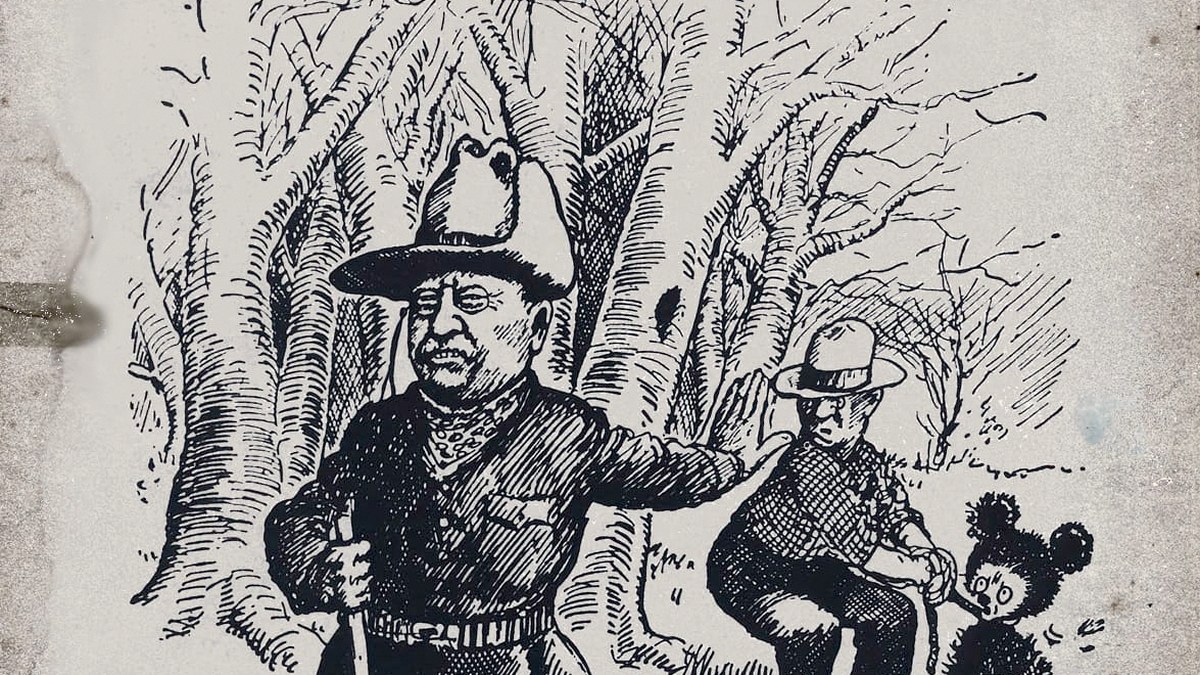
By the middle of November 1902, the hunting party in the canebrakes of Sharkey County, Mississippi, had a problem. Other hunters in camp had found bears. The President of the United States had not.
So his guide went and got one. Holt Collier's dogs ran down a black bear and brought it to bay. The bear was badly hurt in the fight. Collier struck it with the stock of his rifle, tied it to a tree, and sent for Theodore Roosevelt.
Roosevelt looked at the stunned, roped animal and refused to shoot it. To him it was not a fair shot. Within days the story was in newspapers across the country, and within a year there was a stuffed toy named for him. The toy is the part everyone knows. The guide who found the bear, and what happened to the bear afterward, are the parts most of us were never told.
A hunt in the Delta
Roosevelt came to Mississippi at the invitation of Governor Andrew H. Longino, for a black bear hunt in the Smedes Plantation area of southern Sharkey County, near the town of Onward. The U.S. Fish and Wildlife Service identifies the animal he was after as the Louisiana black bear, a subspecies of the American black bear.
More American Memories
Explore Our "Remember When" Archive of Treasured Decades →The exact day of the famous moment depends on whose record you read. The National Park Service dates it to November 14, 1902. The Theodore Roosevelt Center at Dickinson State University puts it on November 15.
The guide
Holt Collier was born enslaved, about 1846, on Home Hill Plantation in Jefferson County, Mississippi, the property of the family of General Thomas Hinds. According to the Mississippi Encyclopedia, he was a teenager when he ran away and served on behalf of the Confederacy with the 9th Texas Cavalry.
After the war he made his name in the Delta as a hunter and guide. The Encyclopedia credits him with killing more than 3,000 bears in his lifetime, a number that comes from reports of his career, not a count anyone kept.
What happened at the tree
The usual version ends with Roosevelt sparing the bear. The record does not.
The bear was already badly mauled by the dogs. According to the Park Service, Roosevelt refused to shoot it but asked that it be put out of its misery, and it was killed with a hunting knife. On November 16, the Richmond Times ran the story under the headline "The President Killed No Bear." The hunt went on, and a record at the Theodore Roosevelt Center still places Roosevelt at Smedes on November 18. He went home from Mississippi without a bear.
The Smithsonian gives the bear's weight as 235 pounds.
From a cartoon to a toy
Also on November 16, 1902, the Washington Post ran a cartoon by Clifford Berryman titled "Drawing the line in Mississippi." It showed Roosevelt with his rifle, refusing to shoot a bear held on a rope. Berryman drew the bear small and round, more like a cub than the animal in the canebrake. Berryman kept the little bear in his cartoons for years, and it became his signature.
The Library of Congress is careful on one point: Berryman made the bear famous, but he did not invent the toy.
That was Morris and Rose Michtom, who ran a candy shop in Brooklyn and also made stuffed animals. After the cartoon, they made a toy bear and called it "Teddy's Bear." Family accounts say Morris Michtom wrote to Roosevelt for permission to use his name. The Smithsonian describes that story as family lore, and the Theodore Roosevelt Presidential Library says no such letter has been found.
The bears sold, and the Michtoms built a company on them. Smithsonian records date the Ideal Novelty and Toy Company to around 1903, though some accounts say 1907.
At almost the same moment, an ocean away, a German company was arriving at the same idea. Richard Steiff of the Steiff firm designed a toy bear, catalogued as the 55 PB, in 1902 and showed it at the Leipzig trade fair in 1903. The Park Service presents the two bears as parallel inventions.
What became of Holt Collier
The two men hunted together again. In October 1907, Collier led Roosevelt on another bear hunt, this time near the Tensas River in Louisiana.
Collier died in 1936 and was buried at Live Oak Cemetery in Greenville, Mississippi. The state put up a historical marker there in 1996. In 2004, Congress established the Holt Collier National Wildlife Refuge in the Mississippi Delta. Not far off, the Fish and Wildlife Service also manages the Theodore Roosevelt National Wildlife Refuge, near the site of the 1902 hunt. The President and his guide each have a refuge in the same corner of Mississippi.
- One of the Michtoms' early bears, made by Ideal around 1903, is in the collection of the Smithsonian's National Museum of American History. It came to the museum in January 1964, a gift of Mr. and Mrs. Kermit Roosevelt. Check the museum's site for whether it is on display before you go.
-
🏛️
The Ideal teddy bear, c. 1903, Smithsonian National Museum of American History: si.edu ↗
-
🏛️
Holt Collier National Wildlife Refuge, Mississippi: fws.gov ↗
-
🏛️
Holt Collier historical marker, Live Oak Cemetery, Greenville: mdah.ms.gov ↗
-
🏛️
Berryman's cartoon, Library of Congress: loc.gov ↗
Join the Conversation
"Do you still have a teddy bear from your childhood, or one you handed down to your kids?"
DailyVibeX American History Community
- National Park Service, Theodore Roosevelt Birthplace, "The Story of the Teddy Bear": https://www.nps.gov/thrb/learn/historyculture/storyofteddybear.htm ↗
- National Park Service, "Origin of the Teddy Bear": https://www.nps.gov/articles/teddybear.htm ↗
- National Park Service, Theodore Roosevelt Inaugural NHS, teddy bear history: https://www.nps.gov/thri/learn/kidsyouth/teddybearhistory.htm ↗
- National Park Service, "Steiff Teddy Bear": https://home.nps.gov/articles/000/steiff-teddy-bear.htm ↗
- U.S. Fish and Wildlife Service, Theodore Roosevelt National Wildlife Refuge: https://www.fws.gov/refuge/theodore-roosevelt ↗
- U.S. Fish and Wildlife Service, Holt Collier National Wildlife Refuge: https://www.fws.gov/refuge/holt-collier ↗
- U.S. Fish and Wildlife Service, "Theodore Roosevelt and the Teddy Bear": https://www.fws.gov/story/theodore-roosevelt-teddy-bear ↗
- U.S. Fish and Wildlife Service, Holt Collier profile: https://www.fws.gov/media/holt-collier ↗
- Mississippi Encyclopedia, "Holt Collier": https://mississippiencyclopedia.org/entries/holt-collier/ ↗
- Mississippi Encyclopedia, "Sharkey County": https://mississippiencyclopedia.org/entries/sharkey-county/ ↗
- Mississippi Encyclopedia, "Hunting Camps, Hunt Clubs": https://mississippiencyclopedia.org/entries/hunting-camps-hunt-clubs/ ↗
- Mississippi Department of Archives and History, Holt Collier marker: https://mississippimarkers.mdah.ms.gov/marker/holt-collier ↗
- Theodore Roosevelt Center, Dickinson State University, black bear hunting: https://www.theodorerooseveltcenter.org/subject/black-bear-hunting/ ↗
- Theodore Roosevelt Center, Smedes remarks record, Nov. 18, 1902: https://www.theodorerooseveltcenter.org/digital-library/o288855/ ↗
- Theodore Roosevelt Center, 1907 Louisiana hunt record: https://www.theodorerooseveltcenter.org/digital-library/o301617/ ↗
- Theodore Roosevelt Center, Louisiana canebrakes record: https://www.theodorerooseveltcenter.org/digital-library/o301598/ ↗
- Theodore Roosevelt Presidential Library, teddy bear name: https://www.trlibrary.com/tr/myths/teddy-name ↗
- Library of Congress, "Drawing the line in Mississippi": https://www.loc.gov/item/2008678324/ ↗
- Library of Congress, "To the Woods!": https://www.loc.gov/item/2021669741/ ↗
- Library of Congress, Chronicling America teddy bear guide: https://guides.loc.gov/chronicling-america-teddy-bear/selected-articles ↗
- National Archives, Clifford Berryman exhibit: https://www.archives.gov/exhibits/running-for-office/characters.php ↗
- National Archives, Berryman biography: https://www.archives.gov/press/press-kits/berryman-cartoons/berryman-bio.html ↗
- Smithsonian National Museum of American History, teddy bear object record: https://www.si.edu/object/teddy-bear:nmah_491375 ↗
- Smithsonian, teddy bear fact sheet: https://americanhistory.si.edu/press/fact-sheets/teddy-bear ↗
- Margarete Steiff GmbH, "120 Years Teddy": https://corporate.steiff.com/en/steiff-teddy/120-years-teddy/ ↗
- Brooklyn Public Library, "Teddy Bears of Brooklyn": https://www.bklynlibrary.org/blog/2014/12/31/teddy-bears-brooklyn ↗
Sponsored Historical & Heritage Features
Step Into Pine Hollow: 20 Complete American Stories
Warm, character-rich tales of small-town resilience, family heirlooms, and neighborly kindness.
Explore All 20 Stories →More Surprising American History
Route 66 Turns 100: How the Mother Road Began
Route 66 didn't open with a ribbon. It began with a vote in North Carolina, an argument over a number, and a road that was mostly unpaved.
Did Paul Revere Really Shout "The British Are Coming"?
The line everyone learned isn't in any of Revere's own accounts. What he did that night, in his own words, is a better story than the poem.
Why Veterans Day Is on November 11
The date comes from one hour in 1918. The name came from a veteran in Birmingham, Alabama. And for a few years in the 1970s, the holiday wasn't in November at all.