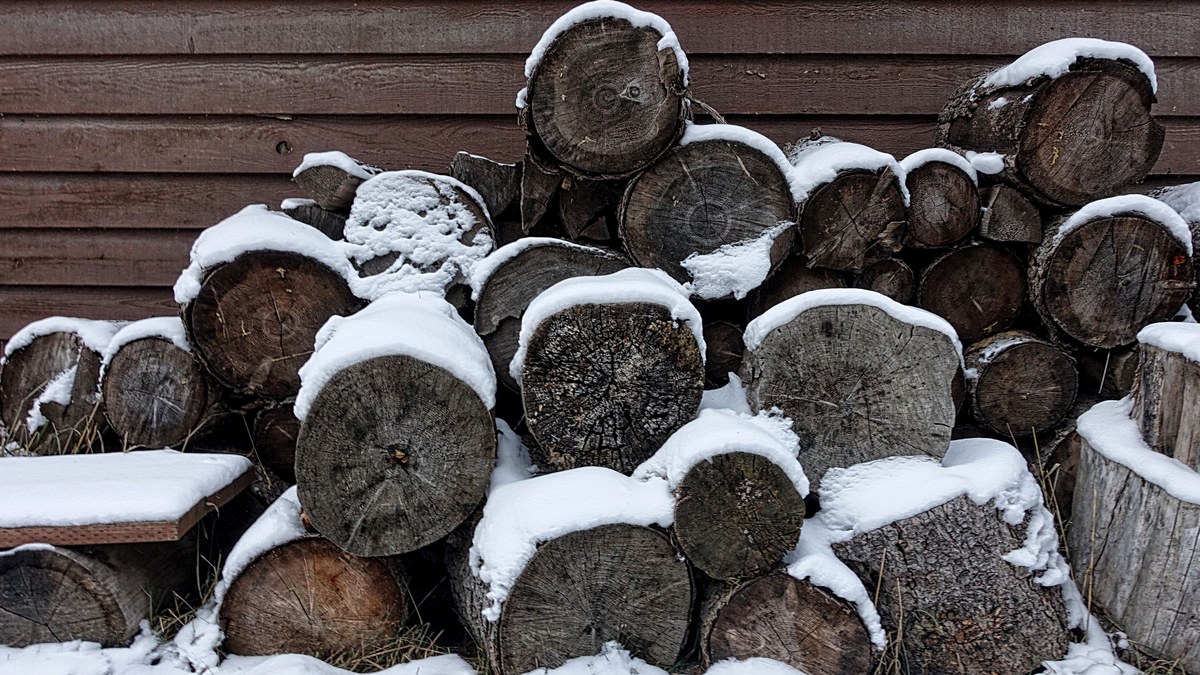
Buying firewood used to be a handshake deal with a neighbor who had a truck and a chainsaw. Plenty of people still buy it that way. But the words used to sell it can be slippery, and the wood itself is not always ready to burn. Here is what a cord really is, how to check what you got, and how to tell if your wood is dry.
What is a full cord?
A cord is a legal unit of measure. The Ohio Department of Agriculture puts it plainly: a cord is 128 cubic feet of wood, which is a stack 4 feet high, 4 feet deep, and 8 feet long, with the pieces stacked tightly.
The national weights and measures handbook published by the National Institute of Standards and Technology (NIST) says firewood should be sold by the cord or by a fraction of a cord, and that the buyer should get a delivery ticket showing the amount sold. Each state sets its own rules, so check with your state's weights and measures office if something seems off.
What about a face cord or a rick?
This is where people get shortchanged. "Face cord" and "rick" are not standardized units. They usually mean a stack 4 feet high and 8 feet long, but only one row deep, and that row can be any length of log. Ohio does not allow firewood to be sold using those terms at all. Other states handle it differently.
A little math shows why it matters. If a face cord is one row of 16-inch logs, stacked 4 feet high and 8 feet long, it holds about 43 cubic feet. That is one third of a full cord. If the logs are 12 inches long, it is only one quarter of a cord. Same name, very different amount of heat.
Bottom line: ask the seller how many cubic feet, or what fraction of a full cord, you are getting. Write it down.
How to measure a delivery
You only need a tape measure and a calculator.
Example: a stack 8 feet long, 4 feet high, and 2 feet deep is 64 cubic feet. Divide by 128 and you get 0.5, a half cord.
Is your wood seasoned?
"Seasoned" means the wood has dried long enough to burn well. Wet wood burns cool and smoky, gives off less heat, and builds up creosote in the chimney faster, which raises your chimney fire risk. (Our wood stove safety guide covers that.)
The EPA's Burn Wise program says firewood should have a moisture content under 20 percent. It recommends drying wood for at least six months, and at least twelve months for hardwoods like oak.
Signs your wood is dry, according to the EPA:
- It is darker in color than fresh cut wood.
- It has cracks in the ends.
- It feels lighter in weight.
- Two pieces knocked together make a hollow sound, not a dull thud.
The surest test is an inexpensive moisture meter. Split a piece and press the pins into the fresh face in the middle, because the outside dries faster than the inside.
How to stack and store firewood
- Off the ground. Stack on pallets, rails, or a rack so moisture does not wick up from the soil.
- Cover the top only. The EPA says to cover the top of the pile and leave the sides open so air can move through.
- Away from the house. Cornell Cooperative Extension recommends keeping your main woodpile about 30 feet from your home. Bring in only what you will burn in a day or two.
Buy local, burn local
Firewood can carry tree-killing insects and diseases to new places. The National Park Service says firewood bought within 10 miles of where you burn it is best, and 50 miles is too far. If you are heading to a cabin or a campground, buy the wood when you get there.
Grandpa judged firewood by sound, weight, and the cracks in the ends. Those signs still work, and the EPA lists them today. What is new is a cheap moisture meter that settles the argument in seconds, and a rule that the seller owes you a delivery ticket. Use both, and you will know exactly what you bought.