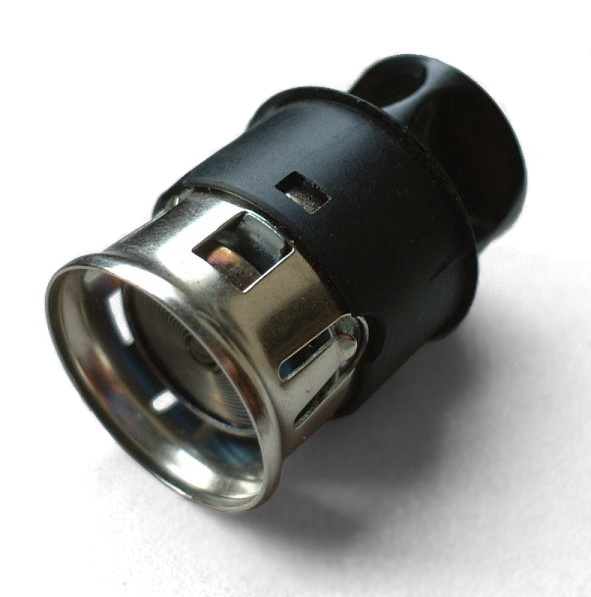
You pushed the knob in and waited. A few seconds later came a soft click, and the knob popped back out. Pull it from the dash and the end glowed bright orange, a tight little spiral of hot metal.
Kids weren't supposed to touch it. Most of us tried anyway, at least once.
That round socket in the dashboard is one of the most successful accidents in car history. It was built for one job, and it ended up doing a completely different one.
A Dashboard Accessory From the 1920s
Car lighters started showing up as factory options and standard equipment around 1925 and 1926, alongside early car radios and better lights.
The first versions used a "coil and reel" design. The heating element was attached to a cord that pulled out of the dash and reeled back in. It worked, but it was clumsy.
The Pop-Out Lighter
The design most of us remember, the cordless knob that pops out when it's ready, came from a Connecticut company called Casco. It developed the version in 1956 and patented it in 1960, and it became the standard in American cars.
How It Worked
- Inside the knob was a flat spiral of metal ribbon, the heating element.
- Pushing the knob in connected that coil to the car's 12-volt electrical system.
- Electricity flowing through the coil heated it until it glowed.
- When it got hot enough, a heat-sensitive clip inside the socket let go, and a spring pushed the knob back out with that familiar click.
The whole trick was a small, round, powered hole in the dashboard. And that hole turned out to be very useful.
Everything Else Moved In
Accessory makers noticed that every car came with a ready-made 12-volt outlet. So they built plugs to fit it.
In the 1970s and '80s, that meant CB radios, radar detectors, plug-in coffee warmers, and spotlights. Later came cell phone chargers, GPS units, and dash cams. The plug shape stayed the same because the socket shape stayed the same.
Eventually the industry wrote it down as an official standard (SAE J563), so a plug from one company would fit a socket from another. Center contact positive, outer wall negative.
Why the Lighter Disappeared
As fewer people smoked, automakers started dropping the lighter itself. Many cars began offering it as part of an optional "smoker's package" along with the ashtray.
The socket stayed but got a new label: power outlet. Here's the catch: newer power outlets often aren't built to take the heat of an old lighter, and some won't even accept one. Today, many new cars skip the round socket entirely in favor of USB ports.
Still Around?
Plenty of cars on the road still have the round socket, usually with a plastic cap instead of a lighter. Old pop-out lighters with chrome knobs are easy to find at swap meets and car shows, and restorers hunt for the right one to finish a dashboard.
What was the first gadget you ever plugged into your car's lighter socket?
Sources
- "From Car Cigarette Lighter to 12V Accessory Socket," Lifewire
- "Cigarette lighters: The new cupholders?" *CNN Money*, Nov. 2003
- "How Much Longer Will Cars Have Cigarette Lighter Ports?" Hackaday, Feb. 2024
- "A Tribute to the Cigarette Lighter Plug," Jalopnik, May 2014
Related Reading
- [another remember-when slug]
- [another category slug]