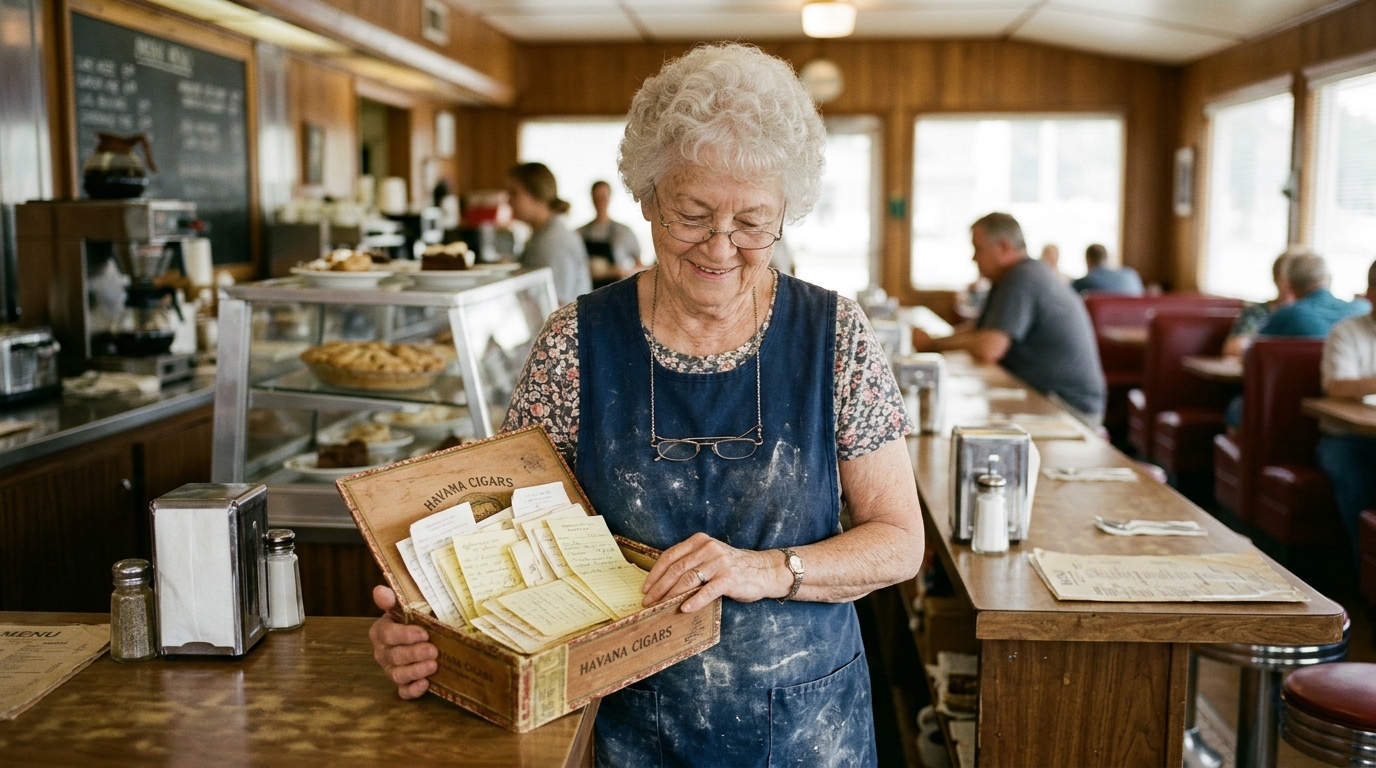
The health inspector folded his notice in half and set it on the counter next to the pie case, like that made it smaller.
"December first, Mrs. Kessler," he said. "New vent hood and a fire suppression system. I'm sorry. I really am."
Dot Kessler looked at the paper. She didn't pick it up.
"Coffee's on the house," she said. "Since you drove all this way to ruin my week."
He left a five on the counter anyway.
Tyler waited until the bell over the door stopped ringing. Then he unfolded the notice and read the bottom line.
"Gran. Twenty-two thousand dollars?"
"I can read, hon."
"Do you have twenty-two thousand dollars?"
Dot poured herself a cup of coffee, which she almost never did during business hours, and looked out the window at Main Street. The stoplight changed from red to green with nobody waiting.
"I've got a diner," she said.
Tyler had been back in Pine Hollow four months. The tech company in Columbus had laid off his whole team in one fifteen-minute video call. He told everyone he was "taking some time." What he was really doing was flipping eggs for his grandmother and wondering what came next.
He had plenty of ideas for the diner. Online ordering. A new sign. A website. Dot had listened to every one of them the way she listened to the weather report: politely, and without believing a word.
But Tyler knew numbers. And that night, after close, he went looking for some.
Dot kept the books in a drawer under the register. The bank statements were thin. The savings account was thinner. Forty-eight years of pie had paid for the building, the stools, and not much else.
Then, on the shelf above the drawer, behind the extra napkins, he found the cigar box.
It was an old King Edward box, the paper label worn soft as felt. Inside were slips of paper. Hundreds of them. Order-pad pages, napkins, the backs of envelopes. Every one had a name or initials, a date, and an amount.
*R.M. Two eggs, toast, coffee. $1.85. 3/12/80.*
*Glass works boys (4). Lunch all week. $41.00. 1986.*
*Sorensen. Supper for the family. Pay you when the plant reopens. 1986.*
The plant never reopened.
Tyler sat down on the kitchen floor with the box in his lap and added them up on his phone. He did it twice, sure he'd made a mistake.
He hadn't.
Twenty-six thousand, four hundred dollars. Forty-eight years of meals Dot had never collected a penny for.
"You put that back," Dot said.
He hadn't heard her come down the stairs. She was in her robe, reading glasses on the chain around her neck.
"Gran, this is more than the hood costs. These people owe you. Half of them are still in town. I could make a list and call them..."
"You will do no such thing."
"It's your money."
"It's not money." She took the box out of his hands, gently, the way you'd take scissors from a child. "These aren't debts, hon. They're receipts. Every one of these is a night somebody in this town didn't go to bed hungry. That's paid in full."
She put the lid on and set the box back on the shelf.
"Now go to bed."
Tyler went. He didn't sleep.
At two in the morning he came down for a glass of water and saw the kitchen light still on. Dot had gone back upstairs. But she had left the cigar box on the prep table.
The lid was open. The IOUs had been taken out and sorted into neat little stacks, the way you'd sort papers you were about to throw away.
Under the stacks, flat on the bottom of the box, was a sheet of paper Tyler hadn't seen before. Typed. Signed. Dated three days ago.
It was a letter to a real estate agent in Marietta. Listing the building for sale.
Dot was going to close the diner.
And she hadn't told a soul.